Anti-aging · Study
UA-30 and Ageing: A New Molecular Target Shows Promise in Naturally Aged Mice
Journal of Experimental Medicine, October 5 issue · 19/10/2026 · added by men35 desk
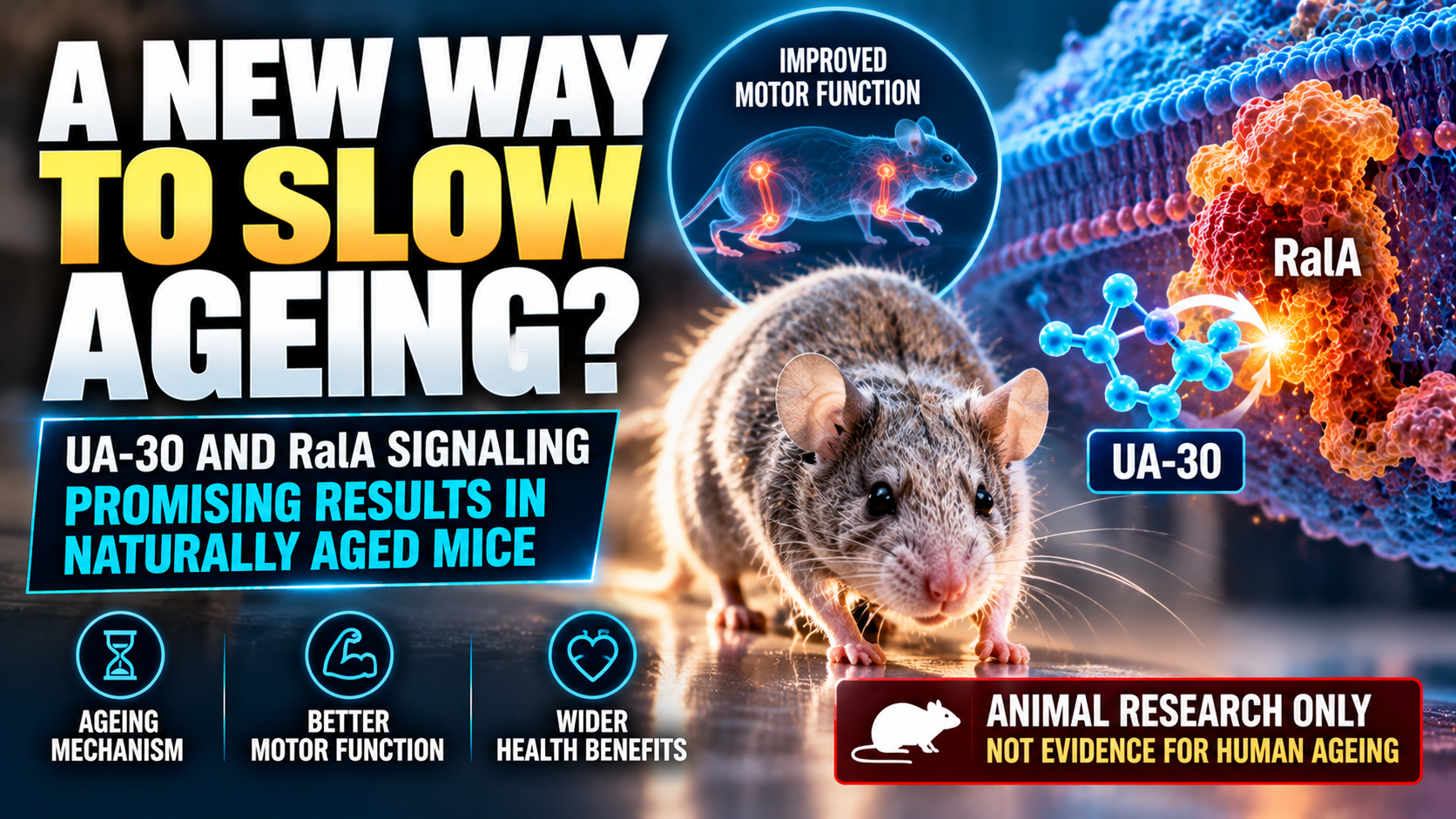
Could targeting a single cell-signaling protein help preserve muscle function as the body ages? A 2026 study in the Journal of Experimental Medicine reports promising results for UA-30, an experimental compound that targets RalA signaling. The findings are intriguing—but they remain preclinical.
𝐊𝐄𝐘 𝐁𝐄𝐍𝐄𝐅𝐈𝐓𝐒
Explains how RalA signaling may contribute to age-related muscle decline.
Summarizes mouse findings involving muscle strength and function, frailty, and fibrosis.
Explores the connection between RalA, mitochondrial function, and ageing.
Separates promising laboratory results from established human treatments.
𝐖𝐇𝐀𝐓 𝐈𝐅 𝐌𝐔𝐒𝐂𝐋𝐄 𝐀𝐆𝐄𝐈𝐍𝐆 𝐂𝐎𝐔𝐋𝐃 𝐁𝐄 𝐓𝐀𝐑𝐆𝐄𝐓𝐄𝐃 𝐀𝐓 𝐈𝐓𝐒 𝐌𝐎𝐋𝐄𝐂𝐔𝐋𝐀𝐑 𝐑𝐎𝐎𝐓𝐒?
Age-related muscle decline is not simply about losing strength. Changes inside muscle tissue can affect how well it repairs itself, how efficiently its cells produce energy, and how easily everyday movement becomes tiring.
Scientists are investigating whether some of these changes can be influenced by targeting specific molecular pathways.
A study published in the Journal of Experimental Medicine on October 5, 2026, examined UA-30, an experimental compound that inhibits a signaling protein called RalA. Researchers tested the compound in naturally aged mice and reported improvements across several measures associated with ageing and muscle function.
That is a promising scientific lead—not evidence of a proven anti-ageing treatment in people.
𝐖𝐇𝐀𝐓 𝐈𝐒 𝐑𝐚𝐥𝐀?
RalA, short for Ras-related protein Ral-A, is involved in cellular signaling. Proteins such as RalA help cells coordinate processes that influence their behavior and function.
In this study, researchers identified RalA as a direct molecular target of UA-30. They found that inhibiting RalA reduced activity in the JNK–Smad signaling pathway, which is associated with fibrosis, or the buildup of excess connective tissue.
The researchers also reported improved mitochondrial function. Mitochondria help cells produce usable energy, making their performance relevant to tissues with substantial energy demands, including skeletal muscle.
These findings offer a possible explanation for the compound's effects. They do not establish that RalA inhibition will produce the same outcomes in ageing humans.
𝐖𝐇𝐀𝐓 𝐃𝐈𝐃 𝐓𝐇𝐄 𝐌𝐎𝐔𝐒𝐄 𝐒𝐓𝐔𝐃𝐘 𝐅𝐈𝐍𝐃?
The team reported several notable results:
Less muscle damage: Ten weeks of UA-30 treatment reduced muscle fibrosis and atrophy in naturally aged mice.
Better physical function: Treated animals showed improvements in measures of muscle function and mobility.
Changes in ageing indicators: The researchers reported reduced frailty and slower changes in epigenetic-age measures.
Longer survival: The study also reported extended lifespan in mice.
An important mechanistic result strengthened the findings: when researchers increased the activity of a constitutively active form of RalA, many of UA-30's anti-fibrotic and anti-ageing effects were substantially diminished.
This supports a role for RalA in the effects observed, although it does not prove that the pathway is the only mechanism involved.
The results are encouraging because they involve more than one biological measure. However, animal outcomes do not reliably predict the size—or even the presence—of benefits in humans.
𝐖𝐇𝐘 𝐓𝐇𝐈𝐒 𝐌𝐀𝐓𝐓𝐄𝐑𝐒 𝐀𝐅𝐓𝐄𝐑 𝟑𝟓
Muscle function matters well before old age. Maintaining strength, balance, and the ability to recover from physical demands can help preserve independence later in life.
But the study does not show that men over 35 should take UA-30, nor does it establish that RalA-targeting compounds prevent sarcopenia in humans.
The practical lesson is more modest: researchers are investigating the molecular processes behind age-related muscle deterioration, rather than treating muscle loss as an unavoidable consequence of getting older.
For now, established habits—including regular resistance exercise, adequate nutrition, sufficient sleep, and management of chronic health risks—remain more defensible strategies for supporting muscle health than experimental anti-ageing compounds.
𝐖𝐇𝐀𝐓 𝐒𝐂𝐈𝐄𝐍𝐂𝐄 𝐌𝐔𝐒𝐓 𝐏𝐑𝐎𝐕𝐄 𝐍𝐄𝐗𝐓
Before UA-30 could be considered a treatment for people, researchers would need to establish its safety, appropriate dosing, and effects in human clinical studies.
They would also need to determine whether the changes seen in mice translate into meaningful improvements in human muscle strength, mobility, healthy lifespan, or age-related disease outcomes.
A compound that changes an ageing-related biomarker is not automatically a therapy that helps people live longer or healthier lives.
The study is an important step in investigating RalA as a potential target, but it is not the final word.
𝐌𝐄𝐍𝟑𝟓 𝐓𝐀𝐊𝐄𝐀𝐖𝐀𝐘
UA-30 gives researchers a promising way to investigate how RalA signaling, muscle fibrosis, and mitochondrial function interact during ageing. In naturally aged mice, the compound improved several measures linked to physical decline.
For men over 35, the finding is worth watching—not a reason to seek out an experimental compound or replace established health practices.
𝐁𝐎𝐓𝐓𝐎𝐌 𝐋𝐈𝐍𝐄
UA-30 is a promising research candidate, not a proven human anti-ageing treatment. The next critical question is whether targeting RalA can safely deliver meaningful benefits in people.
For informational purposes only. This is not medical advice — consult a doctor before changing medication, supplements or training.