Health · News
A Seven-Day Water Fast: The Big Caveat Behind the Longevity Headlines
ScienceDaily, October 5 · 15/10/2026 · added by men35 desk
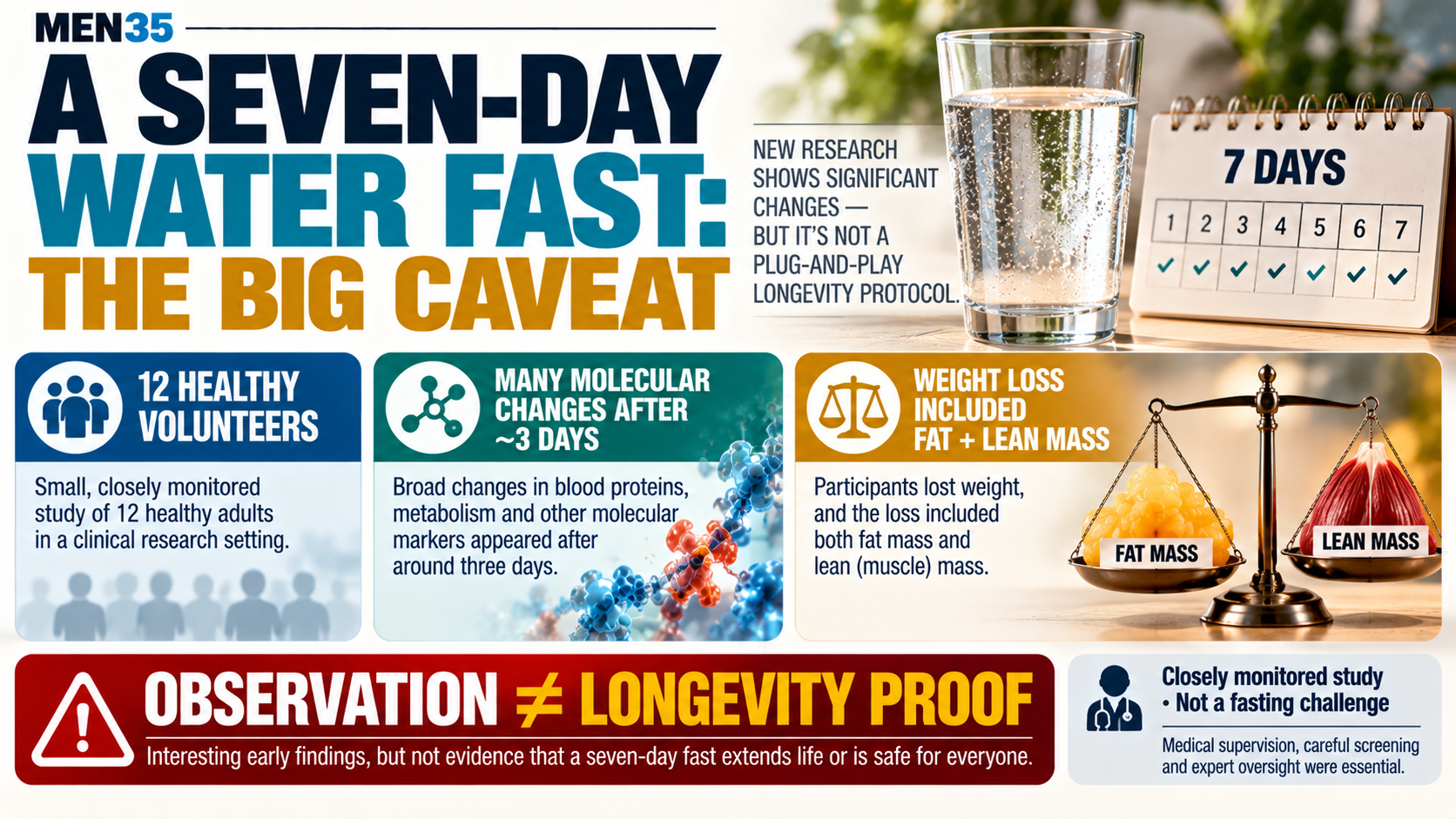
What happens when people go seven days without food? In a closely monitored study of just 12 healthy volunteers, researchers found widespread changes in blood proteins, with many of the most noticeable shifts emerging after about three days. The findings offer a rare look at how the body responds to prolonged fasting—but they do not establish a longevity benefit, and the weight lost included lean mass as well as fat.
KEY BENEFITS
Understand what a small human study actually found during a seven-day water-only fast.
Learn why some molecular changes appeared only after roughly three days.
Discover why weight loss is not the same as improved long-term health.
Understand why a prolonged fast should not be treated as a do-it-yourself longevity protocol.
𝐓𝐇𝐄 𝐅𝐈𝐍𝐃𝐈𝐍𝐆 𝐈𝐒 𝐈𝐍𝐓𝐄𝐑𝐄𝐒𝐓𝐈𝐍𝐆. 𝐓𝐇𝐄 𝐒𝐀𝐌𝐏𝐋𝐄 𝐈𝐒 𝐒𝐌𝐀𝐋𝐋.
A seven-day water-only fast sounds like a dramatic test of human biology. But the headline needs a crucial detail: the study involved only 12 healthy volunteers, who were closely monitored throughout the fast.
The research, originally published in Nature Metabolism in 2024 and revisited in a ScienceDaily report on October 5, 2026, tracked roughly 3,000 proteins in participants’ blood before, during and after the fast.
Researchers found that many proteins changed during prolonged calorie restriction. Some of the broader molecular changes became apparent after approximately three days without calories.
That is useful evidence about how the body responds to fasting. It is not proof that a seven-day fast makes people live longer, prevents disease or is safe for everyone.
𝐖𝐇𝐀𝐓 𝐂𝐇𝐀𝐍𝐆𝐄𝐃 𝐀𝐅𝐓𝐄𝐑 𝐃𝐀𝐘 𝐓𝐇𝐑𝐄𝐄?
During the first two to three days without food, the body shifts away from relying primarily on recently consumed glucose and increasingly uses stored energy, including fat.
The researchers observed another layer of change emerging around day three: broad shifts in circulating proteins associated with different organs and biological systems.
Overall, around one third of the proteins measured changed significantly during the fasting period. Some changes involved proteins associated with the extracellular matrix—the structural network that supports tissues, including structures in the brain.
The researchers also identified molecular patterns that could not be explained by weight loss alone. These findings may help scientists understand which responses are associated with fasting itself and which might be related to changes in body composition.
But there is an important distinction: detecting a biological change does not establish that the change is beneficial. Some molecular shifts may be helpful, some may be neutral, and others could reflect physiological stress or carry potential risks.
𝐓𝐇𝐄 𝐖𝐄𝐈𝐆𝐇𝐓 𝐋𝐎𝐒𝐒 𝐖𝐀𝐒𝐍’𝐓 𝐉𝐔𝐒𝐓 𝐅𝐀𝐓
Participants lost an average of about 5.7 kg over seven days. That may sound impressive, but the total included both fat mass and lean mass.
Lean mass includes muscle and other non-fat tissue, as well as water-rich components. It is therefore not correct to describe all the weight lost as body fat.
After participants resumed eating, most of the lost lean mass returned within three days, while much of the fat loss remained. This suggests that short-term scale changes during a fast can reflect fluid and other lean-tissue changes—not just fat reduction.
For men over 35, preserving muscle matters. Muscle supports strength, mobility and independence as people age. A rapid drop on the scale should not automatically be treated as a better health outcome.
𝐓𝐇𝐄 𝐁𝐈𝐆 𝐂𝐀𝐕𝐄𝐀𝐓: 𝐓𝐇𝐈𝐒 𝐖𝐀𝐒𝐍’𝐓 𝐀 𝐋𝐎𝐍𝐆𝐄𝐕𝐈𝐓𝐘 𝐓𝐑𝐈𝐀𝐋
The study was designed to map the body's molecular response to complete calorie restriction. It was not a large, long-term trial designed to establish whether fasting prevents heart disease, slows human ageing or extends lifespan.
The researchers used existing genetic and population data to investigate possible health implications of the observed protein changes. Those analyses can generate hypotheses, but they do not prove that fasting itself delivers the predicted benefits.
The study also cannot tell us how a seven-day fast compares with less extreme approaches, such as a sustainable calorie deficit, a balanced diet or time-restricted eating. Those are different interventions and need to be assessed on their own evidence.
A small, closely monitored study can reveal important biology. It cannot settle the wider question of whether prolonged fasting is a useful or safe strategy for long-term health.
𝐓𝐇𝐄 𝐒𝐀𝐅𝐄𝐓𝐘 𝐐𝐔𝐄𝐒𝐓𝐈𝐎𝐍
A seven-day water-only fast is not a casual wellness experiment. Prolonged fasting can cause dizziness, low blood pressure, dehydration, electrolyte disturbances and loss of lean tissue. Risks can be higher for people with diabetes, kidney or heart conditions, a history of disordered eating, or medicines that affect blood glucose or blood pressure.
Participants in the study were closely monitored. That context matters when interpreting the findings; it should not be removed from the headline and replaced with a do-it-yourself challenge.
This article does not recommend attempting a prolonged fast. Anyone considering a major dietary intervention—particularly anyone with a medical condition or taking prescription medication—should discuss it with a qualified healthcare professional first.
𝐌𝐄𝐍𝟑𝟓 𝐓𝐀𝐊𝐄𝐀𝐖𝐀𝐘
The study gives scientists a detailed look at how the body adapts to a week without food. It shows that molecular responses extend beyond the early switch in fuel use, with many changes becoming apparent after roughly three days. But the study was small, closely supervised and not designed to prove longevity benefits.
𝐁𝐎𝐓𝐓𝐎𝐌 𝐋𝐈𝐍𝐄
A seven-day water fast is a research intervention, not a plug-and-play longevity protocol. The molecular findings are worth studying, but they do not prove that prolonged fasting extends life or is appropriate for everyone. The most responsible takeaway is to understand the evidence—not turn a small study into a challenge.
For informational purposes only. This is not medical advice — consult a doctor before changing medication, supplements or training.