Strength · Video
Peptides Are Trending: What Is Approved, Proven or Still Experimental?
Jeff Nippard — YouTube: Peptides Are Insane, published September 28, 2026. · 13/10/2026 · added by men35 desk
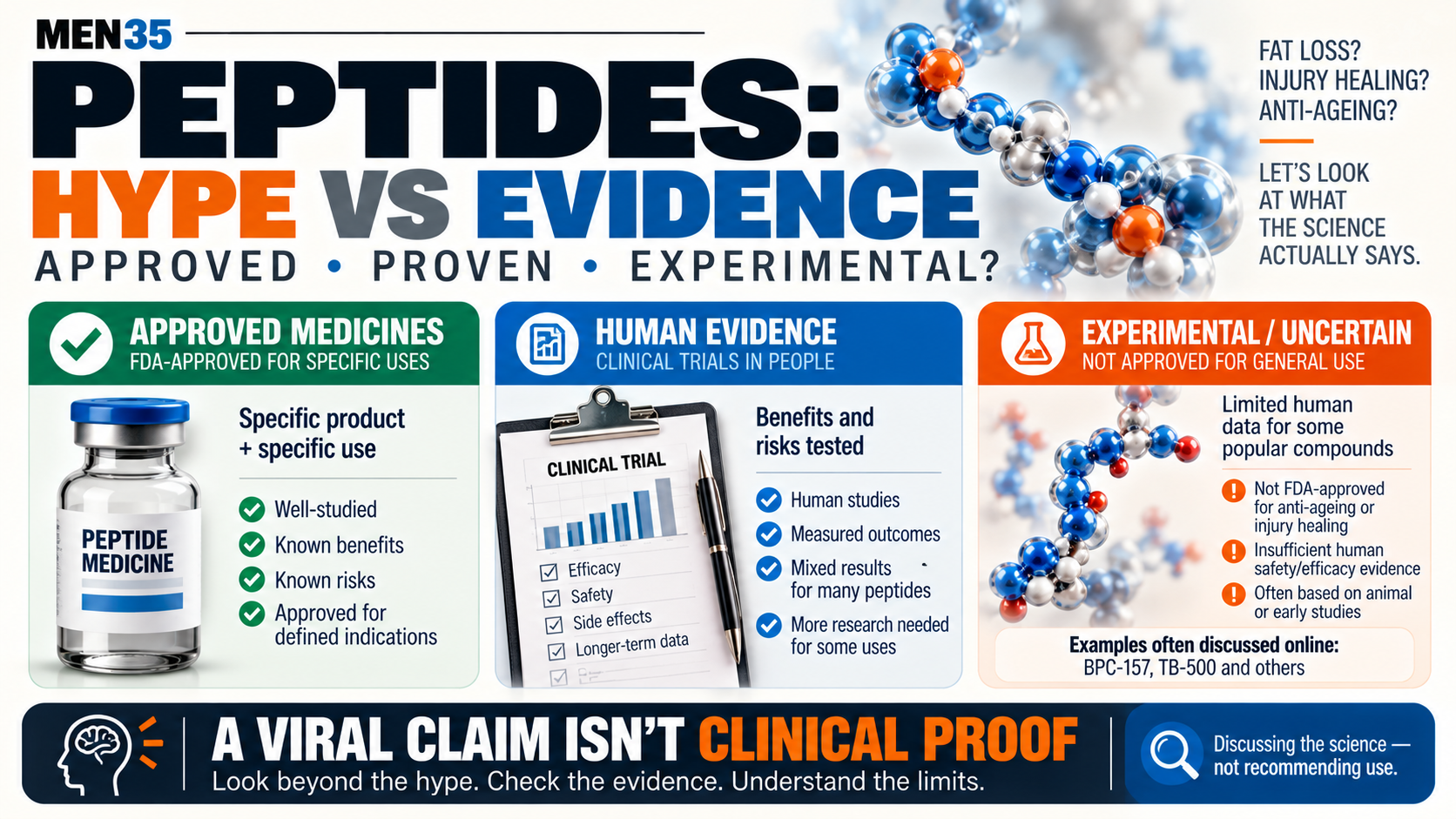
Peptides have become a major topic in fitness, fat loss, injury recovery and longevity. Jeff Nippard’s viral video Peptides Are Insane, published on September 28, 2026, brought the debate to a huge audience. But popularity is not proof. For men over 35, the essential questions are which peptide medicines are approved for specific uses, which claims have credible human evidence, and which compounds remain experimental.
KEY BENEFITS
Understand why peptide-based medicines are not all the same.
Separate approved medical treatments from experimental compounds.
Learn why animal studies and personal testimonials are not enough.
Recognise safety and product-quality concerns around unapproved injectables.
𝐖𝐇𝐘 𝐏𝐄𝐏𝐓𝐈𝐃𝐄𝐒 𝐀𝐑𝐄 𝐄𝐕𝐄𝐑𝐘𝐖𝐇𝐄𝐑𝐄
Peptides are short chains of amino acids. In the body, they can act as hormones, signalling molecules or parts of larger biological systems.
Some peptide-based medicines have transformed medical care. Semaglutide, for example, is a peptide-based medicine approved in specific formulations for defined indications, including type 2 diabetes and chronic weight management. Its benefits and risks have been investigated in extensive human clinical trials.
But this does not mean every compound marketed as a “peptide” is effective, safe or suitable for the same purposes.
Jeff Nippard’s September 28 video examines peptides associated with fat loss, injury recovery and anti-ageing. It is a useful discussion starter, not a substitute for clinical evidence or medical advice.
Watch the original video: https://www.youtube.com/watch?v=H6SiAe-VObA
𝐓𝐇𝐄 𝐓𝐇𝐑𝐄𝐄 𝐂𝐀𝐓𝐄𝐆𝐎𝐑𝐈𝐄𝐒 𝐓𝐎 𝐊𝐍𝐎𝐖
𝐀𝐏𝐏𝐑𝐎𝐕𝐄𝐃 𝐅𝐎𝐑 𝐀 𝐒𝐏𝐄𝐂𝐈𝐅𝐈𝐂 𝐔𝐒𝐄
Some peptide medicines have undergone regulatory review and human trials for particular medical conditions.
For example, semaglutide has approved uses that include type 2 diabetes and chronic weight management, depending on the product and patient eligibility. Its evidence cannot be automatically extended to muscle growth, tendon repair or slowing biological ageing.
Approval applies to a specific product and indication—not to every claim made about a molecule.
𝐏𝐑𝐎𝐌𝐈𝐒𝐈𝐍𝐆, 𝐁𝐔𝐓 𝐍𝐎𝐓 𝐏𝐑𝐎𝐕𝐄𝐍 𝐅𝐎𝐑 𝐄𝐕𝐄𝐑𝐘 𝐂𝐋𝐀𝐈𝐌
A peptide may show an interesting biological effect in a laboratory or animal study. That is a starting point, not proof that it will safely deliver the same benefit in humans.
Researchers must establish suitable dosing, effectiveness, side effects and longer-term safety. Early human studies may help answer these questions, but small or short trials cannot establish every claimed benefit.
The same standard applies to anti-ageing claims: a change in a biomarker does not prove that a person will live longer or remain healthier for longer.
𝐄𝐗𝐏𝐄𝐑𝐈𝐌𝐄𝐍𝐓𝐀𝐋 𝐎𝐑 𝐈𝐍𝐀𝐃𝐄𝐐𝐔𝐀𝐓𝐄𝐋𝐘 𝐒𝐓𝐔𝐃𝐈𝐄𝐃
Compounds such as BPC-157 and TB-500 are frequently promoted online for injury recovery and tissue repair. However, the evidence is not comparable to that supporting well-studied, approved medicines.
The US Food and Drug Administration identifies concerns about the safety of certain substances used in compounded products, including BPC-157 and the TB-500 fragment. These concerns include limited human safety information, possible immune reactions and uncertainty about impurities and product characterisation.
The FDA states that it lacks sufficient information to know whether these substances would cause harm through certain proposed routes of administration. That uncertainty is important: lack of adequate safety evidence is not proof of safety.
Do not assume that a product labelled “research use only” is suitable for human use.
𝐓𝐇𝐄 𝐂𝐑𝐈𝐓𝐈𝐂𝐀𝐋-𝐓𝐇𝐈𝐍𝐊𝐈𝐍𝐆 𝐁𝐎𝐗
PEPTIDES ARE TRENDING—WHAT IS APPROVED, PROVEN OR STILL EXPERIMENTAL?
Before believing a peptide claim, ask four questions:
Is the exact product approved? Check the regulator, formulation and approved indication.
What human evidence exists? Look for well-designed clinical trials, not just animal studies or testimonials.
What outcome improved? Weight loss, pain scores, tendon healing, muscle growth and longer healthspan are different claims requiring different evidence.
What are the risks? Consider side effects, interactions, uncertain dosing, contamination and long-term safety.
A compound can be biologically interesting without being an effective treatment. And an approved medicine can still be inappropriate for someone who does not meet its clinical indications.
𝐖𝐇𝐀𝐓 𝐌𝐄𝐍 𝟑𝟓+ 𝐒𝐇𝐎𝐔𝐋𝐃 𝐓𝐀𝐊𝐄 𝐀𝐖𝐀𝐘
If your goal is fat loss, begin with a sustainable nutrition plan, resistance training, sleep and appropriate medical care. If you have a persistent injury, get a proper diagnosis rather than relying on an online peptide protocol. If your interest is longevity, prioritise interventions with meaningful human outcome evidence.
Prescription peptide medicines can be valuable when used appropriately under medical supervision. Experimental products sold through informal online channels are a different proposition.
Do not self-inject an unapproved peptide based on an influencer's experience or a seller's claims.
𝐌𝐄𝐍𝟑𝟓 𝐓𝐀𝐊𝐄𝐀𝐖𝐀𝐘
Peptides are a broad category—not a shortcut to better health. Some peptide medicines have strong clinical evidence for specific uses; others have limited human data or unresolved safety questions. Evaluate the exact compound, product, claim and evidence before drawing conclusions.
𝐁𝐎𝐓𝐓𝐎𝐌 𝐋𝐈𝐍𝐄
A viral headline is not clinical proof. The right question is not whether peptides work in general, but which specific peptide has been shown to work safely for a particular purpose.
For informational purposes only. This is not medical advice — consult a doctor before changing medication, supplements or training.