Anti-aging · Video
Can AI Help Us Live Healthier for Longer? Inside Retro Biosciences’ Longevity Strategy
The $180M Anti-Aging Pill Just Entered Human Trials (Sam Altman’s Retro) · 17/10/2026 · added by men35 desk
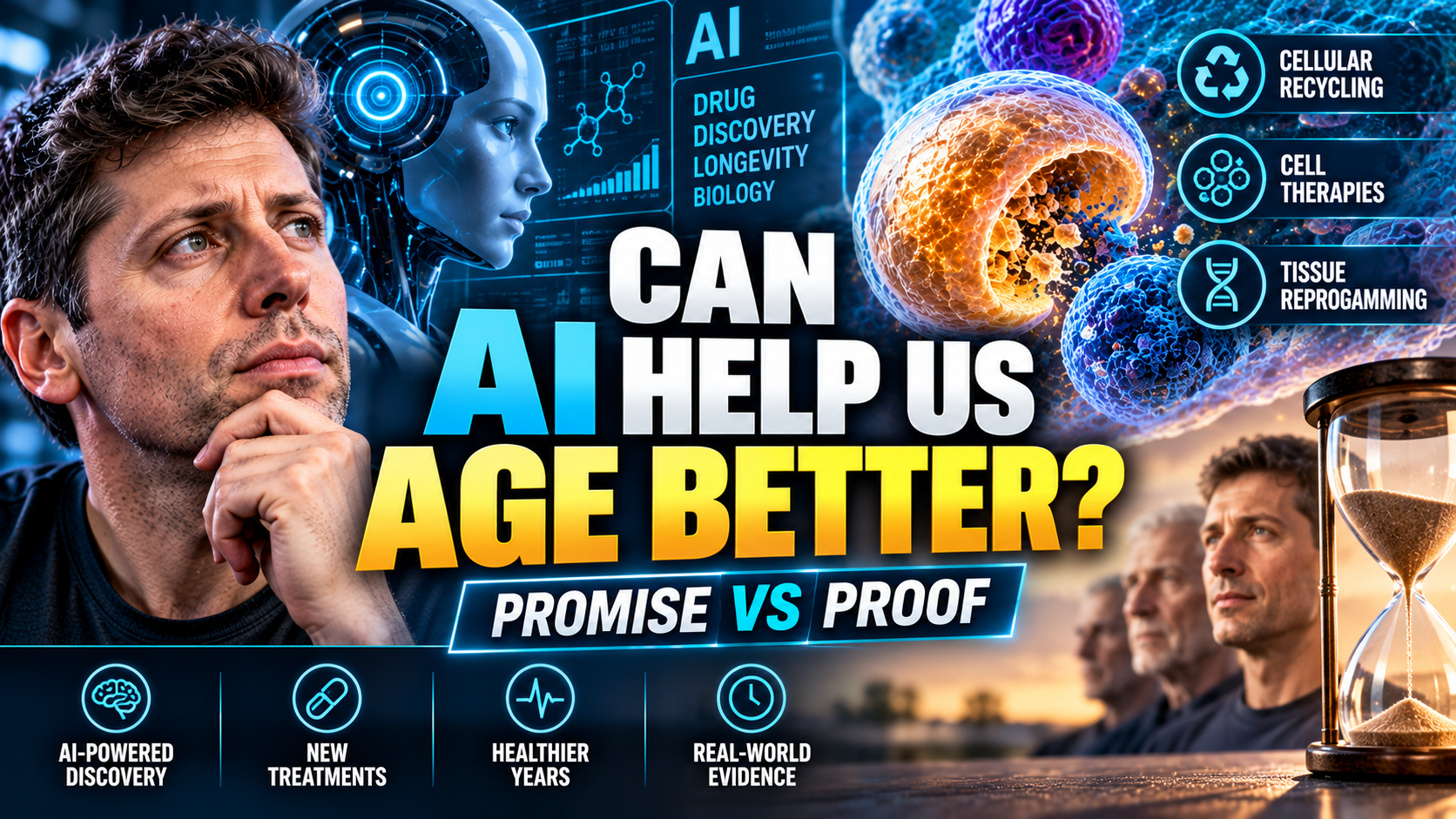
Retro Biosciences is pursuing several approaches to age-related disease, including cellular recycling, cell therapies and tissue reprogramming. Its partnership with AI researchers reflects a growing ambition to accelerate drug discovery—but scientific progress must still be proven in clinical trials.
Key Benefits
Explains the broader strategy behind Retro Biosciences.
Shows where AI may help in biological research.
Distinguishes different experimental approaches.
Explains why clinical evidence matters more than funding or hype.
𝗧𝗛𝗘 𝗕𝗜𝗚𝗚𝗘𝗥 𝗚𝗢𝗔𝗟
What if technology could help researchers discover treatments that preserve health for longer—not just treat disease after it appears?
That ambition is attracting major investment. Retro Biosciences, backed by Sam Altman, says its goal is to add ten healthy years to human lifespan. It is pursuing several different approaches, rather than relying on one universal anti-ageing pill.
The goal is bold. The evidence must still catch up.
𝗢𝗡𝗘 𝗖𝗢𝗠𝗣𝗔𝗡𝗬, 𝗦𝗘𝗩𝗘𝗥𝗔𝗟 𝗔𝗣𝗣𝗥𝗢𝗔𝗖𝗛𝗘𝗦
Retro’s published pipeline includes RTR242, an oral drug designed to enhance autophagy; cell-based programmes aimed at conditions such as blood disorders and central nervous system disease; and tissue-reprogramming research.
These are distinct technologies with different risks, targets and development timelines. Progress in one programme does not prove that the others will work.
The company’s first drug to enter human testing, RTR242, is aimed at cellular waste-handling mechanisms relevant to neurodegenerative disease. Its early trial is not designed to demonstrate that people will live longer.
𝗪𝗛𝗔𝗧 𝗔𝗜 𝗖𝗔𝗡 𝗔𝗡𝗗 𝗖𝗔𝗡’𝗧 𝗗𝗢
AI tools can help scientists analyse biological data, generate candidate molecules or proteins, and prioritise experiments. In some areas, this may help researchers explore possibilities faster than traditional methods alone.
But AI-generated candidates still have to work in real biological systems. Researchers need laboratory testing, safety assessment, clinical trials and independent scrutiny.
A promising model result is not a medicine. A successful experiment in cells is not proof of benefit in people. And a human safety trial does not automatically establish effectiveness.
𝗧𝗛𝗘 𝗠𝗘𝗔𝗦𝗨𝗥𝗘 𝗢𝗙 𝗦𝗨𝗖𝗖𝗘𝗦𝗦
The meaningful milestones are not simply fundraising totals or ambitious company statements. They are reproducible results, acceptable safety, improved outcomes for patients and evidence that benefits outweigh risks.
For longevity research, researchers must also be precise about what a treatment is meant to do. Treating a specific age-related disease is a realistic clinical objective; proving that a medicine slows the entire ageing process is a much larger claim.
𝗪𝗛𝗔𝗧 𝗠𝗘𝗡 𝗢𝗩𝗘𝗥 𝟯𝟱 𝗦𝗛𝗢𝗨𝗟𝗗 𝗪𝗔𝗧𝗖𝗛
Look for published human data, clearly described trial phases and measurable health outcomes. Be cautious when headlines turn an experimental therapy into a promise of rejuvenation.
The field is worth following. But no investment round, famous backer or AI partnership can replace clinical proof.
𝗠𝗘𝗡𝟯𝟱 𝗧𝗔𝗞𝗘𝗔𝗪𝗔𝗬
AI may become a valuable tool in longevity medicine, and companies are testing ambitious ideas. The best reason for optimism is rigorous progress—not a promise that ageing has already been solved.
𝗕𝗢𝗧𝗧𝗢𝗠 𝗟𝗜𝗡𝗘
The future of longevity research may be shaped by AI and biotechnology. Whether these technologies help people live healthier for longer will depend on the evidence from human studies.
For informational purposes only. This is not medical advice — consult a doctor before changing medication, supplements or training.