Anti-aging · Study
Can a Heart’s Molecular Age Shift After Transplantation?
Lifespan.io, September 29 · 13/10/2026 · added by men35 desk
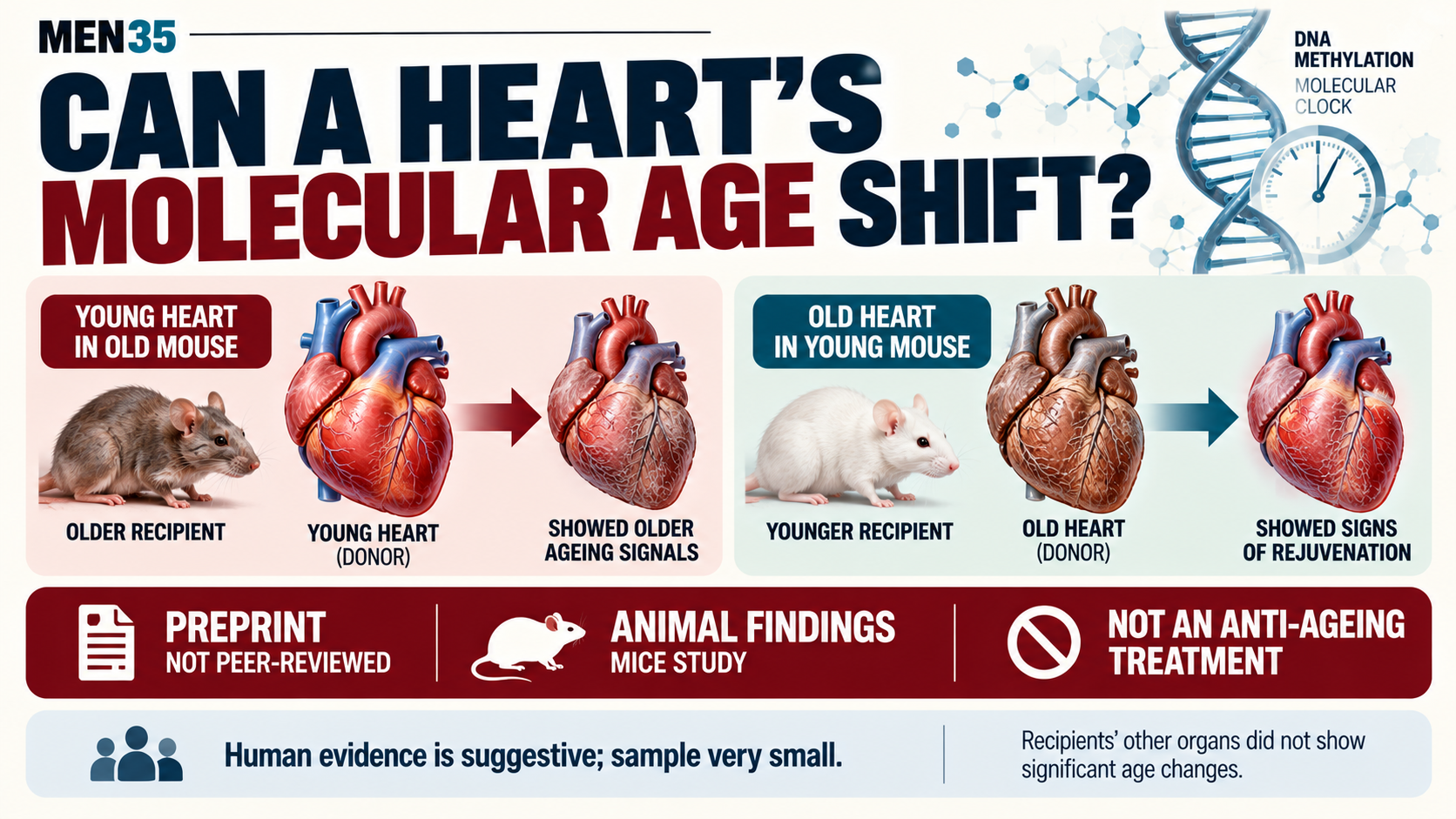
A new, non-peer-reviewed study suggests that a transplanted heart’s molecular ageing signals can shift towards the age of its recipient. In mice, young hearts developed older molecular patterns in older recipients, while older hearts showed signs of molecular rejuvenation in younger recipients. Limited human findings point in the same direction—but this is not evidence that transplantation reverses ageing or extends life.
KEY BENEFITS
Understand how a recipient’s biological environment may influence a transplanted organ.
Learn what researchers observed in young and old mice.
Discover what the preliminary human evidence suggests.
Understand the difference between molecular-age markers and actual rejuvenation.
Separate an intriguing scientific finding from an unproven anti-ageing treatment.
𝗖𝗔𝗡 𝗔𝗡 𝗢𝗥𝗚𝗔𝗡’𝗦 𝗕𝗜𝗢𝗟𝗢𝗚𝗜𝗖𝗔𝗟 𝗖𝗟𝗢𝗖𝗞 𝗦𝗛𝗜𝗙𝗧?
We often think of biological ageing as something determined by an organ’s own history. But what happens when an organ enters a body that is much younger or older than its original owner?
Researchers from Harvard Medical School and collaborating institutions investigated this question by studying transplanted hearts in mice and examining a small set of human heart-transplant samples.
The research, posted on bioRxiv on September 17, 2026, suggests that a heart’s molecular ageing signals can be strongly influenced by the environment of its new host.
The crucial qualification: the paper is a preprint and has not been peer-reviewed. Its findings are preliminary and should not be treated as established clinical evidence.
𝗪𝗛𝗔𝗧 𝗛𝗔𝗣𝗣𝗘𝗡𝗘𝗗 𝗜𝗡 𝗠𝗜𝗖𝗘?
Researchers transplanted hearts between mice of different ages, allowing them to compare the transplanted organ with the recipient’s own tissues.
After four to six months, they examined DNA methylation patterns—chemical marks on DNA that can be used in certain biological-age estimates—and gene-expression profiles.
Two patterns stood out:
Young heart in an older mouse: The transplanted heart developed molecular signals associated with older biological age.
Older heart in a younger mouse: The transplanted heart showed molecular patterns associated with a younger biological age.
Several molecular clocks supported the age-shifting pattern. Gene-expression analysis also identified changes in pathways related to mitochondria, the structures responsible for much of a cell’s energy production.
These findings suggest that an organ’s molecular state is not determined solely by the age it had before transplantation. Signals from its surrounding biological environment may also matter.
However, a molecular clock measures selected biological features. It does not, by itself, prove that the organ has regained youthful function, will remain healthy longer or will extend its recipient’s lifespan.
𝗗𝗢𝗘𝗦 𝗧𝗛𝗘 𝗦𝗔𝗠𝗘 𝗧𝗛𝗜𝗡𝗚 𝗛𝗔𝗣𝗣𝗘𝗡 𝗜𝗡 𝗣𝗘𝗢𝗣𝗟𝗘?
The researchers also examined human heart-transplant data from Brigham and Women’s Hospital.
The wider clinical dataset included 407 transplantations, but the molecular analysis of transplanted heart tissue involved just 11 recipients with substantial age differences between donor and recipient.
DNA-methylation measurements showed patterns broadly consistent with the mouse results: the recipient’s age appeared to be more closely associated with the transplanted heart’s molecular-age signals than the donor’s age.
This is an intriguing observation, but the sample is very small. It cannot establish how consistently the effect occurs across transplant recipients, whether it improves long-term outcomes or whether the same mechanisms explain the findings in humans and mice.
The human results should therefore be regarded as suggestive rather than conclusive.
𝗗𝗢𝗘𝗦 𝗧𝗛𝗘 𝗧𝗥𝗔𝗡𝗦𝗣𝗟𝗔𝗡𝗧 𝗥𝗘𝗝𝗨𝗩𝗘𝗡𝗔𝗧𝗘 𝗧𝗛𝗘 𝗪𝗛𝗢𝗟𝗘 𝗕𝗢𝗗𝗬?
One of the study’s notable observations was that the recipient’s native organs did not show significant, consistent changes in biological-age measurements attributable to the transplant.
In other words, the molecular shifts were primarily observed in the transplanted heart—not as a general rejuvenation effect throughout the recipient’s body.
This distinction matters. Even if an organ’s molecular-age estimate shifts, that does not mean the recipient’s overall biological age has changed.
The research also does not show that receiving a younger donor heart makes a person live longer than they otherwise would. Heart transplantation is a lifesaving treatment for selected patients with serious heart disease, not an anti-ageing procedure for healthy people.
𝗪𝗛𝗬 𝗧𝗛𝗘 𝗙𝗜𝗡𝗗𝗜𝗡𝗚 𝗠𝗔𝗧𝗧𝗘𝗥𝗦
The study raises important questions about how tissues respond to their biological environment. Researchers may be able to use this knowledge to understand ageing mechanisms, develop better biological-age measurements and investigate how organs adapt after transplantation.
It could also inform future research into organ preservation and transplant outcomes. But those are potential research directions, not proven benefits of the findings.
Several questions remain unanswered: Which circulating signals drive the changes? Are the molecular shifts reversible? Do they correspond to better or worse organ function over time? And can any of the mechanisms be studied safely without transplantation?
Further research, independent replication and peer review are needed before strong conclusions can be drawn.
𝗠𝗘𝗡𝟯𝟱 𝗧𝗔𝗞𝗘𝗔𝗪𝗔𝗬
A transplanted heart may carry molecular signals that shift towards the biological age of its new host. The mouse experiments provide the strongest evidence, while the human findings are based on a very small sample. Neither establishes that transplantation reverses ageing or extends lifespan.
𝗕𝗢𝗧𝗧𝗢𝗠 𝗟𝗜𝗡𝗘
An organ’s molecular age may be more flexible than its chronological age suggests—but molecular change is not the same as proven rejuvenation. This preliminary research offers an interesting window into the biology of ageing, not a new anti-ageing treatment.
For informational purposes only. This is not medical advice — consult a doctor before changing medication, supplements or training.