Anti-aging · Video
ER-100: The First Human Trial of Cellular Rejuvenation—Is This the End of Ageing?
YouTube — Original video: The First Human Trial of ER-100. Is This The End of Aging? · 14/10/2026 · added by men35 desk
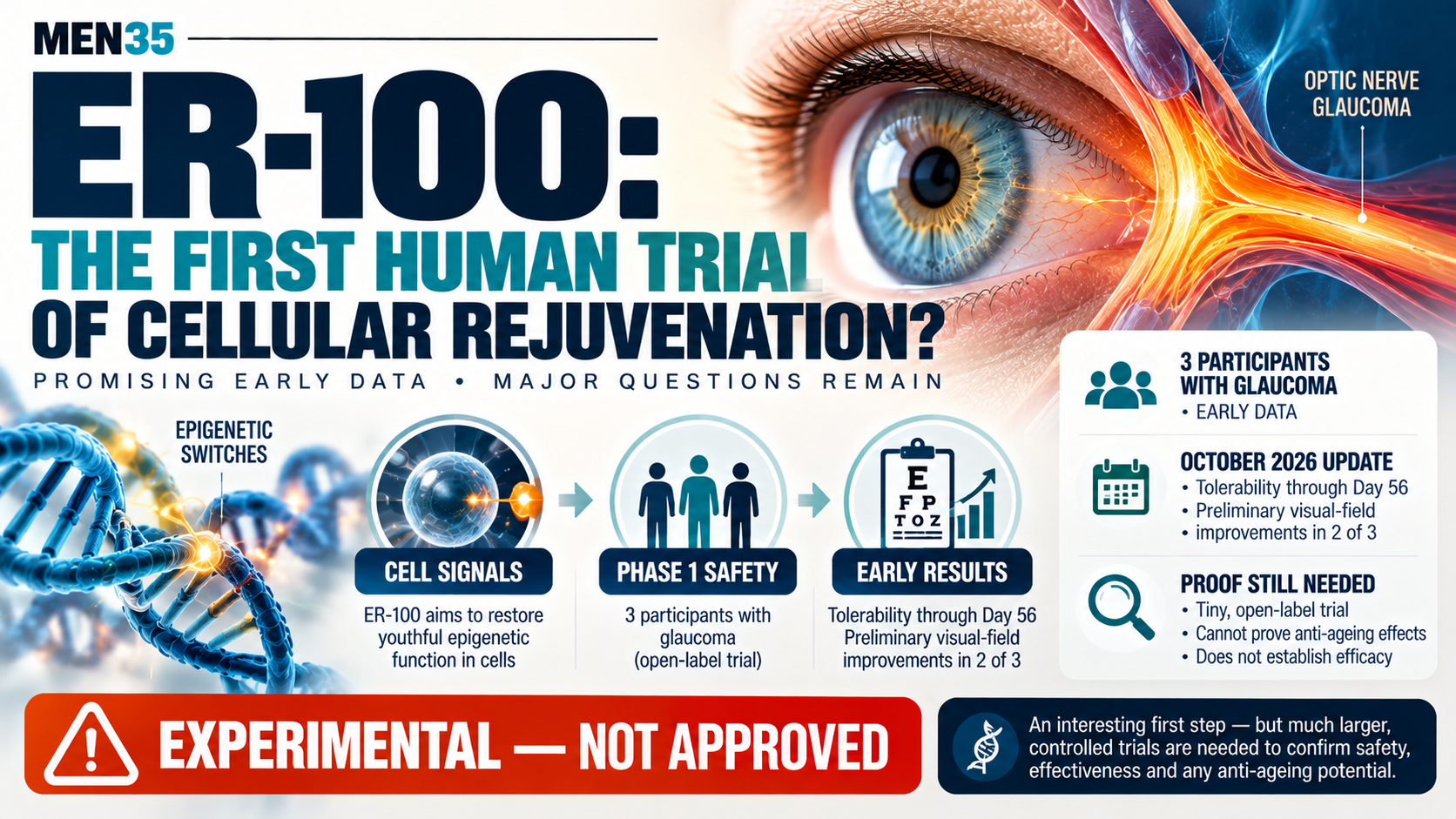
A new experimental therapy is testing whether cells damaged by ageing can be pushed toward a more youthful state. ER-100 has entered human clinical trials for optic-nerve diseases, and early findings have attracted attention. But what has actually been demonstrated—and how far are we from a genuine anti-ageing treatment?
KEY BENEFITS
Understand how partial epigenetic reprogramming is intended to work.
Learn what the first human ER-100 trial is testing.
Separate preliminary vision findings from proof of cellular rejuvenation.
Understand the major safety and scientific questions that remain.
𝐖𝐇𝐘 𝐄𝐑-𝟏𝟎𝟎 𝐈𝐒 𝐆𝐄𝐓𝐓𝐈𝐍𝐆 𝐀𝐓𝐓𝐄𝐍𝐓𝐈𝐎𝐍
Most established treatments for age-related conditions manage symptoms, slow disease progression or target particular biological pathways. ER-100 takes a different approach: it aims to restore aspects of cellular function by modifying the epigenetic instructions that help control gene activity.
Developed by Life Biosciences, ER-100 is an investigational gene therapy being studied in people with optic neuropathies, including open-angle glaucoma and non-arteritic anterior ischemic optic neuropathy (NAION).
In January 2026, the US Food and Drug Administration cleared the company's investigational new drug application, allowing clinical testing to proceed. This was permission to investigate the treatment—not FDA approval to market it. The first participant was dosed in June 2026. FDA clearance announcement
𝐇𝐎𝐖 𝐏𝐀𝐑𝐓𝐈𝐀𝐋 𝐄𝐏𝐈𝐆𝐄𝐍𝐄𝐓𝐈𝐂 𝐑𝐄𝐏𝐑𝐎𝐆𝐑𝐀𝐌𝐌𝐈𝐍𝐆 𝐖𝐎𝐑𝐊𝐒
Cells carry DNA, but DNA sequence alone does not determine how a cell behaves. Chemical modifications and regulatory mechanisms—collectively part of the epigenetic system—help control which genes are active.
As cells age or become damaged, some of these patterns can change. Scientists are investigating whether carefully controlled reprogramming can restore aspects of youthful gene activity without erasing a cell's identity.
ER-100 uses three transcription factors: OCT4, SOX2 and KLF4, collectively known as OSK. These factors are delivered to cells using a viral vector. The treatment is designed to activate OSK expression in a controlled manner, with doxycycline used as part of the activation system.
The goal is not to turn an optic-nerve cell into a different cell type. It is to restore aspects of its function while preserving its identity.
That distinction is crucial. Full cellular reprogramming can erase cell identity and create serious safety risks. Partial reprogramming is an attempt to capture some potential benefits while controlling those risks.
However, a plausible biological mechanism is not the same as a proven treatment effect in humans.
𝐖𝐇𝐀𝐓 𝐓𝐇𝐄 𝐅𝐈𝐑𝐒𝐓 𝐇𝐔𝐌𝐀𝐍 𝐃𝐀𝐓𝐀 𝐒𝐇𝐎𝐖𝐒
On October 8, 2026, Life Biosciences announced interim results from the ongoing Phase 1 trial.
The company's report covered three participants with open-angle glaucoma who received ER-100 alongside the study's supporting medication regimen. Through Day 56, the company reported that treatment was well tolerated. It also reported preliminary improvements in visual-field testing in two of the three participants.
Visual-field tests measure how well a person detects light at different points across their field of vision. Changes can be clinically relevant, but findings in such a small group cannot establish that the treatment caused the improvements or that the effect will persist.
The trial is open-label, meaning participants and researchers know the treatment is being administered. Without a suitable comparison group and larger numbers, it is difficult to separate a treatment effect from variability in testing, other influences or chance.
The study's primary purpose is to assess safety and tolerability, with additional assessments exploring visual function. It is too early to conclude that ER-100 restores lost vision reliably.
Read the company's October 8 interim update.
𝐖𝐇𝐀𝐓 𝐒𝐂𝐈𝐄𝐍𝐂𝐄 𝐒𝐓𝐈𝐋𝐋 𝐍𝐄𝐄𝐃𝐒 𝐓𝐎 𝐏𝐑𝐎𝐕𝐄
Several questions remain unanswered:
Safety: Can the treatment be delivered without unacceptable inflammation, immune reactions, unintended gene activity or other complications?
Effectiveness: Does it produce repeatable, clinically meaningful improvements in vision?
Durability: Do any improvements persist over months or years?
Mechanism: Do clinical benefits result from the intended epigenetic restoration?
Generalisability: Could similar approaches work in other tissues, or is the effect specific to particular cells and diseases?
The trial is registered on ClinicalTrials.gov as NCT07290244. Its results will need to be evaluated as more participants are treated and follow-up continues.
Even if ER-100 ultimately proves effective for a particular eye disease, that would not automatically show that it slows whole-body ageing, extends lifespan or prevents age-related diseases elsewhere.
𝐖𝐇𝐀𝐓 𝐈𝐓 𝐌𝐄𝐀𝐍𝐒 𝐅𝐎𝐑 𝐌𝐄𝐍 𝟑𝟓+
ER-100 is scientifically important because it moves cellular reprogramming from preclinical research into human testing. But it is not an anti-ageing treatment people can currently use outside an authorised clinical trial.
Do not confuse experimental gene therapy with commercially marketed “cellular rejuvenation” supplements or unapproved treatments. They are not interchangeable, and evidence for one cannot be used to support claims about another.
For now, the most meaningful development is that researchers can begin testing this approach directly in people. The next milestone is not a bold headline: it is convincing, independently scrutinised evidence of safety and clinical benefit.
𝐌𝐄𝐍𝟑𝟓 𝐓𝐀𝐊𝐄𝐀𝐖𝐀𝐘
Partial epigenetic reprogramming is an emerging approach to restoring aspects of cellular function. ER-100 is an important early test of that idea in humans, but the initial data are limited to a tiny group and short follow-up. More research is needed before anyone can claim that it reverses ageing.
𝐁𝐎𝐓𝐓𝐎𝐌 𝐋𝐈𝐍𝐄
ER-100 is a milestone in longevity research—not proof that ageing has been reversed. Early human findings justify further investigation, but larger and longer trials must establish whether the treatment is safe and truly improves vision.
For informational purposes only. This is not medical advice — consult a doctor before changing medication, supplements or training.