Mind · Study
SLEEP ARCHITECTURE MAY SHAPE STRESS RESILIENCE: WHAT A NEW MOUSE STUDY FOUND
Society for Neuroscience / The Journal of Neuroscience · 02/10/2026 · added by men35 desk
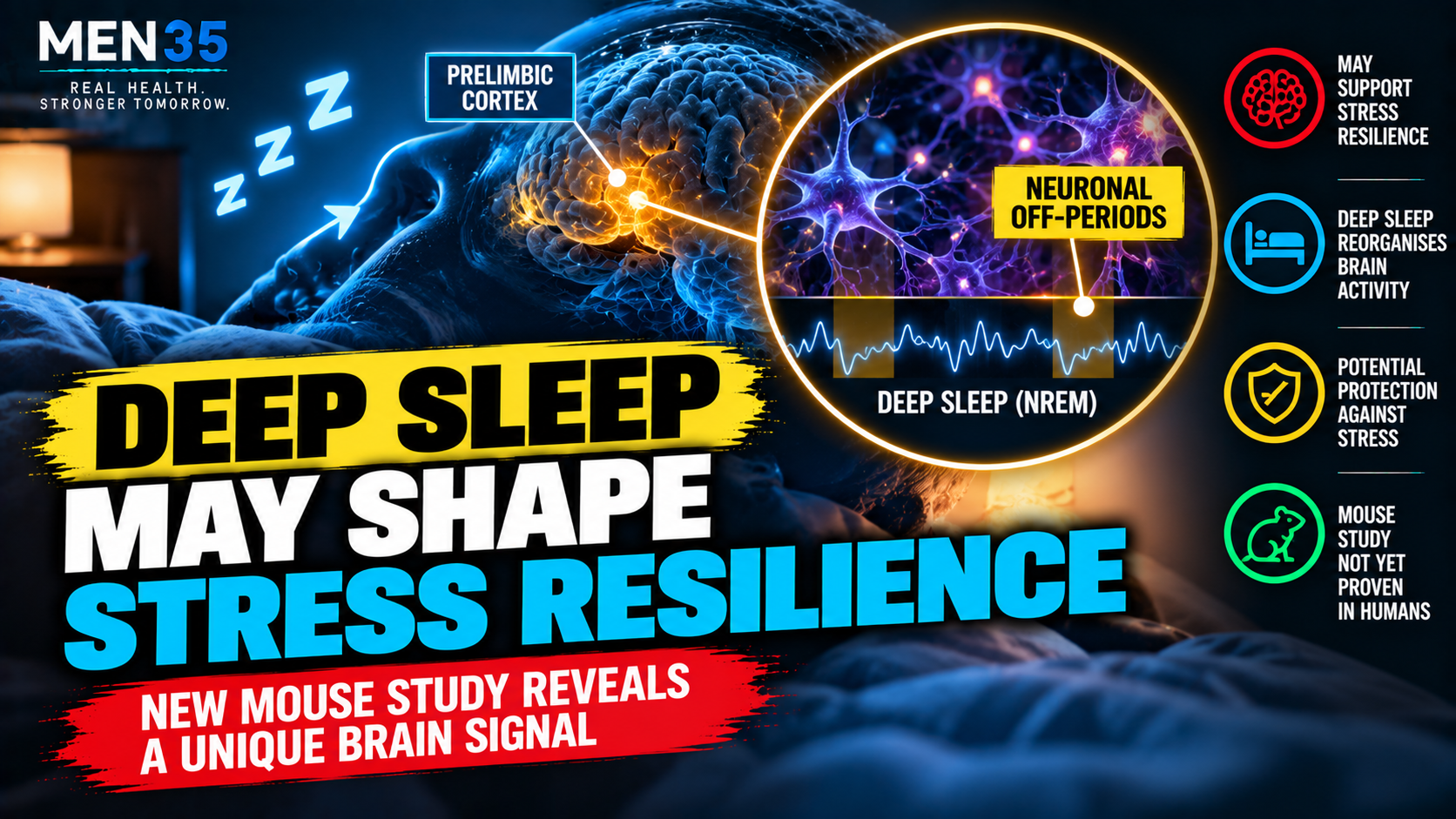
Deep sleep is not simply passive downtime. New research in male mice suggests that the way neurons become temporarily silent and reorganize during NREM sleep may be associated with resilience to stressful experiences. The study identifies a distinctive pattern of brain activity in the prelimbic cortex, but it does not establish a human stress-management protocol or prove that changing deep sleep will make people more resilient.
𝗞𝗘𝗬 𝗕𝗘𝗡𝗘𝗙𝗜𝗧𝗦
• Explains how NREM sleep may interact with the brain's response to stress • Shows what researchers discovered in the prelimbic cortex of male mice • Explains the importance of neuronal “OFF-periods” during NREM sleep • Separates promising animal research from established human evidence • Provides practical sleep-health habits for men 35+ without overstating the study
𝗦𝗟𝗘𝗘𝗣 𝗜𝗦 𝗔𝗖𝗧𝗜𝗩𝗘 𝗕𝗥𝗔𝗜𝗡 𝗪𝗢𝗥𝗞
It is easy to think of sleep as the time when the brain simply shuts down.
Neuroscience tells a different story.
During sleep, the brain continues to display highly organized patterns of electrical and neuronal activity. Different stages of sleep involve different patterns, and NREM sleep is particularly associated with slow-wave activity and periods of reduced neuronal firing.
Researchers are increasingly interested in whether these changes are simply consequences of sleep or whether they actively contribute to how the brain responds to challenges.
A new study provides another piece of that puzzle.
𝗧𝗛𝗘 𝗕𝗥𝗔𝗜𝗡 𝗥𝗘𝗚𝗜𝗢𝗡 𝗧𝗛𝗘𝗬 𝗦𝗧𝗨𝗗𝗜𝗘𝗗
The researchers focused on the prelimbic cortex, a region of the prefrontal cortex involved in regulating responses to emotionally stressful experiences.
They recorded activity from individual neurons and local brain electrical activity in male mice before and after a five-day social-defeat stress paradigm.
The animals were then categorized according to behavioral responses to the stress exposure.
Some showed characteristics associated with resilience, while others showed greater susceptibility.
𝗧𝗛𝗘 𝗦𝗨𝗥𝗣𝗥𝗜𝗦𝗜𝗡𝗚 𝗣𝗔𝗥𝗧: 𝗡𝗘𝗨𝗥𝗢𝗡𝗔𝗟 𝗦𝗜𝗟𝗘𝗡𝗖𝗘
One of the study's central observations involved what the researchers call neuronal “OFF-periods.”
These are periods when populations of neurons become temporarily silent or greatly reduce their firing.
The researchers found that these OFF-periods occurred predominantly during NREM sleep and were strongly associated with local slow-wave activity.
That connection was particularly interesting in the mice that later demonstrated resilience to the stress exposure.
𝗥𝗘𝗦𝗜𝗟𝗜𝗘𝗡𝗧 𝗠𝗜𝗖𝗘 𝗦𝗛𝗢𝗪𝗘𝗗 𝗔 𝗗𝗜𝗙𝗙𝗘𝗥𝗘𝗡𝗧 𝗣𝗔𝗧𝗧𝗘𝗥𝗡
Before the stress exposure, resilient mice showed stronger coupling between the density of neuronal OFF-periods and slow-wave activity.
After the stress exposure, the resilient animals also showed a distinctive reorganization of cortical silence.
The researchers observed more shorter OFF-periods and a more even temporal distribution of these events during NREM sleep.
In addition, stress was associated with a broader redistribution of cortical firing rates, with this effect being particularly pronounced in the resilient animals.
𝗪𝗛𝗬 𝗧𝗛𝗜𝗦 𝗠𝗔𝗧𝗧𝗘𝗥𝗦
The study suggests that resilience may involve more than simply getting a certain number of hours of sleep.
The researchers propose that the ability of local brain networks to reorganize during sleep could be part of the biological mechanisms supporting resilience.
In other words, the question may not only be:
“How much did you sleep?”
It may eventually also involve:
“What happened inside specific brain circuits while you were sleeping?”
That is an important scientific distinction.
However, this remains an experimental finding in mice.
𝗧𝗛𝗘 𝗦𝗟𝗘𝗘𝗣 𝗦𝗜𝗚𝗡𝗔𝗟 𝗔𝗣𝗣𝗘𝗔𝗥𝗘𝗗 𝗕𝗘𝗙𝗢𝗥𝗘 𝗦𝗧𝗥𝗘𝗦𝗦
One of the more interesting observations was that the difference in sleep-related neural activity existed before the experimental stress exposure.
The resilient mice had stronger baseline coupling between neuronal OFF-period density and slow-wave activity.
The researchers therefore identified a pre-existing sleep-related neural signature associated with later behavioral resilience in this animal model.
That does not mean scientists can currently look at a person's sleep and determine whether that individual will cope successfully with future stress.
It means that, within this controlled mouse experiment, certain neural characteristics were associated with the later behavioral response.
𝗧𝗛𝗘 𝗦𝗧𝗨𝗗𝗬 𝗕𝗨𝗜𝗟𝗗𝗦 𝗢𝗡 𝗘𝗔𝗥𝗟𝗜𝗘𝗥 𝗪𝗢𝗥𝗞
The research is part of a broader line of investigation into sleep and stress resilience.
Earlier work from the research group found that NREM sleep was associated with resilience to social stress in male mice. That study reported that resilient animals increased sleep following social-defeat stress and that pre-existing differences in sleep regulation were associated with later resilience.
The new study goes deeper by examining what individual neurons are doing during local sleep in the prelimbic cortex.
This progression—from observing sleep behavior to examining individual neural circuits—is what makes the new research scientifically interesting.
𝗗𝗘𝗘𝗣 𝗦𝗟𝗘𝗘𝗣 𝗜𝗦 𝗡𝗢𝗧 𝗔 𝗠𝗔𝗚𝗜𝗖 𝗦𝗧𝗥𝗘𝗦𝗦 𝗦𝗛𝗜𝗘𝗟𝗗
The study should not be interpreted as proof that increasing deep sleep will automatically protect a person from psychological stress.
It does not establish:
• A specific amount of deep sleep required for resilience • A human brain pattern that predicts resilience • A sleep intervention that prevents stress-related disorders • A supplement that can reproduce the observed neural activity • A clinical treatment based on manipulating NREM sleep
The researchers themselves describe the findings as a framework that may help future studies investigate human markers of stress resilience or susceptibility.
𝗧𝗛𝗘 𝗠𝗢𝗨𝗦𝗘 𝗧𝗢 𝗛𝗨𝗠𝗔𝗡 𝗚𝗔𝗣
This is perhaps the most important point for MEN35 readers.
The experiment was conducted in male mice.
The animals experienced a controlled social-defeat stress paradigm.
Researchers directly recorded neuronal activity from the prelimbic cortex.
Humans experience very different forms of stress, including work pressure, financial concerns, relationship difficulties, illness, sleep disruption and many other factors.
Therefore, the mouse neural signature cannot currently be translated into a specific human protocol.
The finding is a biological clue—not a prescription.
𝗪𝗛𝗔𝗧 𝗠𝗘𝗡𝟯𝟱 𝗥𝗘𝗔𝗗𝗘𝗥𝗦 𝗖𝗔𝗡 𝗔𝗖𝗧𝗨𝗔𝗟𝗟𝗬 𝗗𝗢
Although the new study does not provide a human treatment, it adds to the broader scientific rationale for taking sleep seriously.
For men 35+, practical sleep habits include:
• Maintain a reasonably consistent sleep and wake schedule • Allow enough time for sleep rather than routinely cutting it short • Keep the bedroom dark, quiet and comfortable • Avoid excessive alcohol close to bedtime • Limit caffeine later in the day if it disrupts sleep • Exercise regularly • Get adequate daytime light exposure • Address persistent snoring or suspected sleep apnea with a healthcare professional
These are general sleep-health practices.
They should not be presented as interventions proven by this particular mouse experiment.
𝗗𝗢𝗡'𝗧 𝗧𝗨𝗥𝗡 𝗔 𝗠𝗢𝗨𝗦𝗘 𝗦𝗧𝗨𝗗𝗬 𝗜𝗡𝗧𝗢 𝗔 𝗦𝗨𝗣𝗣𝗟𝗘𝗠𝗘𝗡𝗧 𝗖𝗟𝗔𝗜𝗠
The study does not demonstrate that melatonin, magnesium, GABA, herbs, amino acids or another sleep supplement can reproduce the neural pattern observed in the mice.
This distinction matters because a scientific finding about brain activity can easily become an exaggerated marketing claim.
MEN35 should keep those two things separate.
A product may have evidence for supporting sleep under particular circumstances, but that does not mean it has been shown to reproduce a specific neural signature associated with resilience in mice.
𝗧𝗛𝗘 𝗥𝗘𝗦𝗘𝗔𝗥𝗖𝗛 𝗤𝗨𝗘𝗦𝗧𝗜𝗢𝗡 𝗚𝗢𝗜𝗡𝗚 𝗙𝗢𝗥𝗪𝗔𝗥𝗗
The next step is especially important.
Researchers want to determine whether manipulating sleep in the resilient mice changes the neural patterns identified in the study and alters their behavioral response to stress.
They also hope the work can eventually inform human studies looking for neurobiological markers associated with stress resilience or susceptibility.
That means the science is moving from:
Sleep is associated with resilience.
toward:
Which specific neural mechanisms during sleep might contribute to resilience?
That is a much more precise research question.
𝗠𝗘𝗡𝟯𝟱 𝗦𝗟𝗘𝗘𝗣 𝗔𝗨𝗗𝗜𝗧
You do not need a laboratory to start paying more attention to your sleep.
Take a few minutes to check five areas.
𝗦𝗟𝗘𝗘𝗣 𝗦𝗖𝗛𝗘𝗗𝗨𝗟𝗘
Do you usually go to bed and wake up at approximately the same times?
𝗦𝗟𝗘𝗘𝗣 𝗘𝗡𝗩𝗜𝗥𝗢𝗡𝗠𝗘𝗡𝗧
Is your bedroom dark, quiet and comfortable?
𝗘𝗩𝗘𝗡𝗜𝗡𝗚 𝗛𝗔𝗕𝗜𝗧𝗦
Are caffeine, alcohol, heavy meals, work or excessive screen time interfering with your final hours before bed?
𝗗𝗔𝗬𝗧𝗜𝗠𝗘 𝗕𝗘𝗛𝗔𝗩𝗜𝗢𝗥
Are you physically active and exposed to natural daylight during the day?
𝗦𝗟𝗘𝗘𝗣 𝗪𝗔𝗥𝗡𝗜𝗡𝗚 𝗦𝗜𝗚𝗡𝗦
Do you regularly snore loudly, wake up gasping, experience excessive daytime sleepiness or repeatedly wake during the night?
If these problems are persistent, discussing them with a healthcare professional may be more useful than simply buying another sleep product.
𝗠𝗘𝗡𝟯𝟱 𝗘𝗩𝗜𝗗𝗘𝗡𝗖𝗘 𝗟𝗔𝗗𝗗𝗘𝗥
𝗘𝗦𝗧𝗔𝗕𝗟𝗜𝗦𝗛𝗘𝗗
Sleep involves coordinated changes in brain activity, and NREM sleep is characterized by slow-wave activity and periods of reduced neuronal firing.
𝗣𝗥𝗘𝗖𝗟𝗜𝗡𝗜𝗖𝗔𝗟
In male mice, neuronal OFF-periods in the prelimbic cortex were strongly associated with NREM slow-wave activity and differed between resilient and susceptible animals following social stress.
𝗘𝗠𝗘𝗥𝗚𝗜𝗡𝗚
The organization and flexibility of local neural activity during sleep may contribute to the biological mechanisms underlying stress resilience.
𝗡𝗢𝗧 𝗬𝗘𝗧 𝗘𝗦𝗧𝗔𝗕𝗟𝗜𝗦𝗛𝗘𝗗
That the same neural pattern predicts stress resilience in humans.
That increasing deep sleep will prevent stress-related illness in humans.
That a particular supplement can reproduce the observed neural signature.
𝗠𝗘𝗡𝟯𝟱 𝗧𝗔𝗞𝗘𝗔𝗪𝗔𝗬
Deep sleep is not simply passive downtime.
This mouse study suggests that the organization of neuronal activity during NREM sleep may be associated with how the brain responds to stress.
The finding is scientifically important because it points toward a possible neural mechanism of resilience.
But it remains animal research.
For men 35+, the practical message is straightforward: protect your sleep, build consistent sleep habits and take persistent sleep problems seriously while researchers continue investigating the deeper neuroscience.
𝗧𝗛𝗘 𝗕𝗢𝗧𝗧𝗢𝗠 𝗟𝗜𝗡𝗘
A new study in male mice found that resilient animals had distinctive patterns of neuronal silence and slow-wave coordination in the prelimbic cortex during NREM sleep.
After stress, these animals also showed a distinctive reorganization of local cortical activity.
The research provides a fascinating clue about how sleep and stress resilience may interact at the level of individual brain circuits.
It does not, however, establish a human stress protocol.
For now, the most useful lesson is simple: sleep deserves a place alongside exercise, nutrition and recovery in a long-term health strategy.
For informational purposes only. This is not medical advice — consult a doctor before changing medication, supplements or training.