Longevity · News
Biological-Age Tests: What Can a Clock Measure—and What Can It Prove?
Biomarkers of Aging Consortium, 2026 conference · 13/10/2026 · added by men35 desk
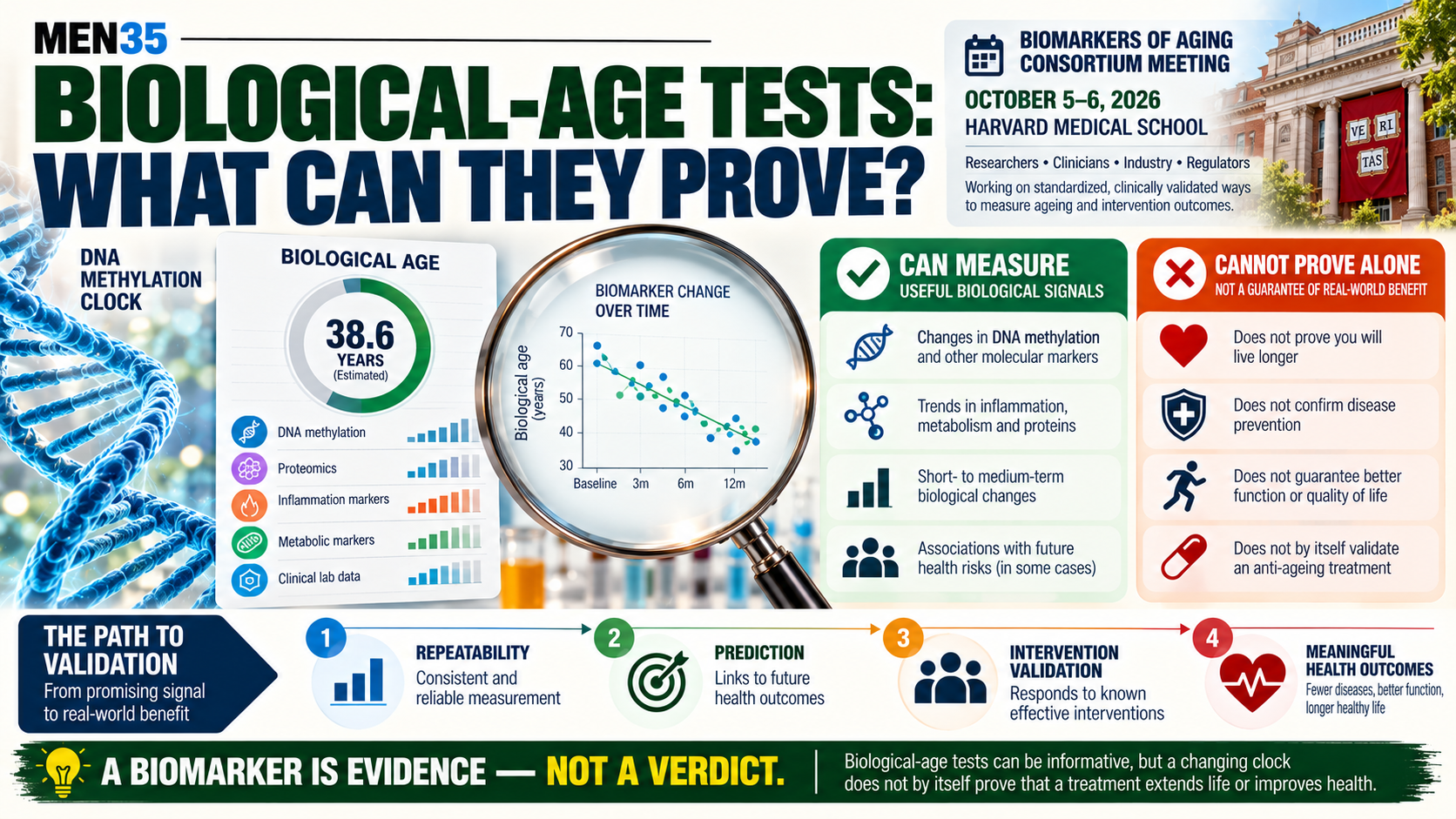
Biological-age tests promise a glimpse into how the body is ageing. But can a DNA-based clock or blood biomarker prove that a man is getting healthier—or that a treatment will help him live longer? As leading researchers gather at Harvard Medical School to discuss standardization and validation, the key challenge is separating promising measurements from proven clinical benefits.
KEY BENEFITS
Understand what biological-age clocks actually measure.
Learn why different tests can give different results.
Discover what scientific validation requires before a test can guide treatment decisions.
See why meaningful health outcomes matter more than an impressive-looking age score.
𝐖𝐇𝐘 𝐁𝐈𝐎𝐋𝐎𝐆𝐈𝐂𝐀𝐋 𝐀𝐆𝐄 𝐈𝐒 𝐆𝐄𝐓𝐓𝐈𝐍𝐆 𝐀𝐓𝐓𝐄𝐍𝐓𝐈𝐎𝐍
On October 5–6, 2026, the Biomarkers of Aging Consortium held its annual conference at the Joseph B. Martin Conference Center at Harvard Medical School. The meeting brought together researchers, clinicians, industry representatives and regulatory stakeholders to discuss better ways to measure ageing and evaluate interventions.
The timing matters. As longevity research moves toward human trials, scientists need reliable tools to assess whether an intervention is doing something useful.
Chronological age is simple: it measures how long someone has lived. Biological age is more complicated. It refers to estimates of biological condition or ageing-related processes, derived from measurements such as DNA methylation, proteins, inflammation, metabolism and physical function.
There is no single, universally accepted biological-age number that captures every aspect of ageing.
𝐖𝐇𝐀𝐓 𝐀 𝐁𝐈𝐎𝐋𝐎𝐆𝐈𝐂𝐀𝐋 𝐂𝐋𝐎𝐂𝐊 𝐂𝐀𝐍 𝐌𝐄𝐀𝐒𝐔𝐑𝐄
Different tests use different signals.
Epigenetic clocks analyse patterns of DNA methylation—chemical tags associated with how genes are regulated.
Blood-based biomarkers may assess inflammation, metabolism or proteins linked to health and ageing.
Physiological measures examine characteristics such as blood pressure, muscle strength, walking speed and physical performance.
Composite tools combine multiple measurements into a score intended to reflect a particular aspect of biological ageing or risk.
Some clocks are designed to estimate chronological age. Others are trained to predict health outcomes, mortality risk or the pace of biological change. Their scores are not interchangeable.
A clock may be useful for research even if it cannot provide a definitive diagnosis for an individual. Its value depends on what it was designed to measure and how well it has been validated for that purpose.
𝐖𝐇𝐀𝐓 𝐈𝐓 𝐂𝐀𝐍𝐍𝐎𝐓 𝐏𝐑𝐎𝐕𝐄 𝐀𝐋𝐎𝐍𝐄
Imagine a supplement lowers a person's biological-age score after three months. That may be worth investigating, but it does not automatically establish that the supplement slowed ageing in a meaningful way.
The change could reflect a real biological response, normal variation, measurement error or a short-term effect that does not persist. Even a reliable marker associated with future health outcomes may not necessarily show that changing the marker itself will improve those outcomes.
Researchers must distinguish three questions:
Can the test measure something reliably? Results should be repeatable and robust.
Does the measurement predict something important? For example, does it relate to later disease, disability or mortality in relevant populations?
Does a treatment-induced change predict a real benefit? This is especially important when a biomarker is proposed as a substitute for longer-term clinical outcomes.
That third step is a major hurdle. A test that predicts risk is not automatically a validated surrogate endpoint for a treatment trial.
𝐖𝐇𝐀𝐓 𝐕𝐀𝐋𝐈𝐃𝐀𝐓𝐈𝐎𝐍 𝐑𝐄𝐐𝐔𝐈𝐑𝐄𝐒
A 2024 review in Nature Medicine, titled “Validation of biomarkers of aging,” described the need to test predictive validity across populations and address differences in measurement methods and generalizability.
An expert-consensus statement published in the Journals of Gerontology: Series A in 2025 identified a range of candidate biomarkers for intervention studies, including DNA methylation clocks, inflammatory markers, blood pressure, muscle strength, walking speed, balance and cognitive health. The authors also noted that further research is needed to determine which combinations work best.
This points toward a more comprehensive approach: molecular markers can provide useful information, but should be considered alongside measures of function and health whenever appropriate.
For a longevity treatment, the strongest evidence would connect a reproducible biomarker change to meaningful outcomes—such as preserved mobility, better cognitive function, fewer serious age-related conditions or improved quality of life. The right endpoints depend on the intervention and the claim being tested.
𝐖𝐇𝐀𝐓 𝐌𝐄𝐍 𝟑𝟓+ 𝐒𝐇𝐎𝐔𝐋𝐃 𝐊𝐍𝐎𝐖
Biological-age tests may be interesting tools for research, but a commercial score should not be treated as a definitive verdict on your health.
Before paying for a test, ask:
What exactly does it measure?
Has the method been independently validated?
Does it predict meaningful outcomes in people like me?
Is there evidence that acting on the result improves health?
Could the result change because of ordinary biological or measurement variation?
A test can be scientifically interesting without being clinically useful. And a lower score does not mean that a product has been proven to reverse ageing.
For men over 35, established health measures—blood pressure, appropriate cholesterol and glucose testing, physical fitness, strength and relevant medical assessments—remain important. These do not provide a single biological-age score, but they can help identify actionable health risks.
𝐌𝐄𝐍𝟑𝟓 𝐓𝐀𝐊𝐄𝐀𝐖𝐀𝐘
Biological-age clocks can help researchers investigate ageing, compare groups and assess potential interventions. Their meaning depends on the method, the population and the outcome being predicted. The field still needs stronger standardization and evidence linking changes in these markers to real-world benefits.
𝐁𝐎𝐓𝐓𝐎𝐌 𝐋𝐈𝐍𝐄
A biological-age score is a measurement, not a promise. The real test is whether it reliably predicts meaningful health outcomes—and whether changing it through an intervention actually improves those outcomes.
For informational purposes only. This is not medical advice — consult a doctor before changing medication, supplements or training.