Strength · Study
Aging Muscle Weakness May Involve a Nerve–Muscle Communication Failure
ScienceDaily · 07/10/2026 · added by men35 desk
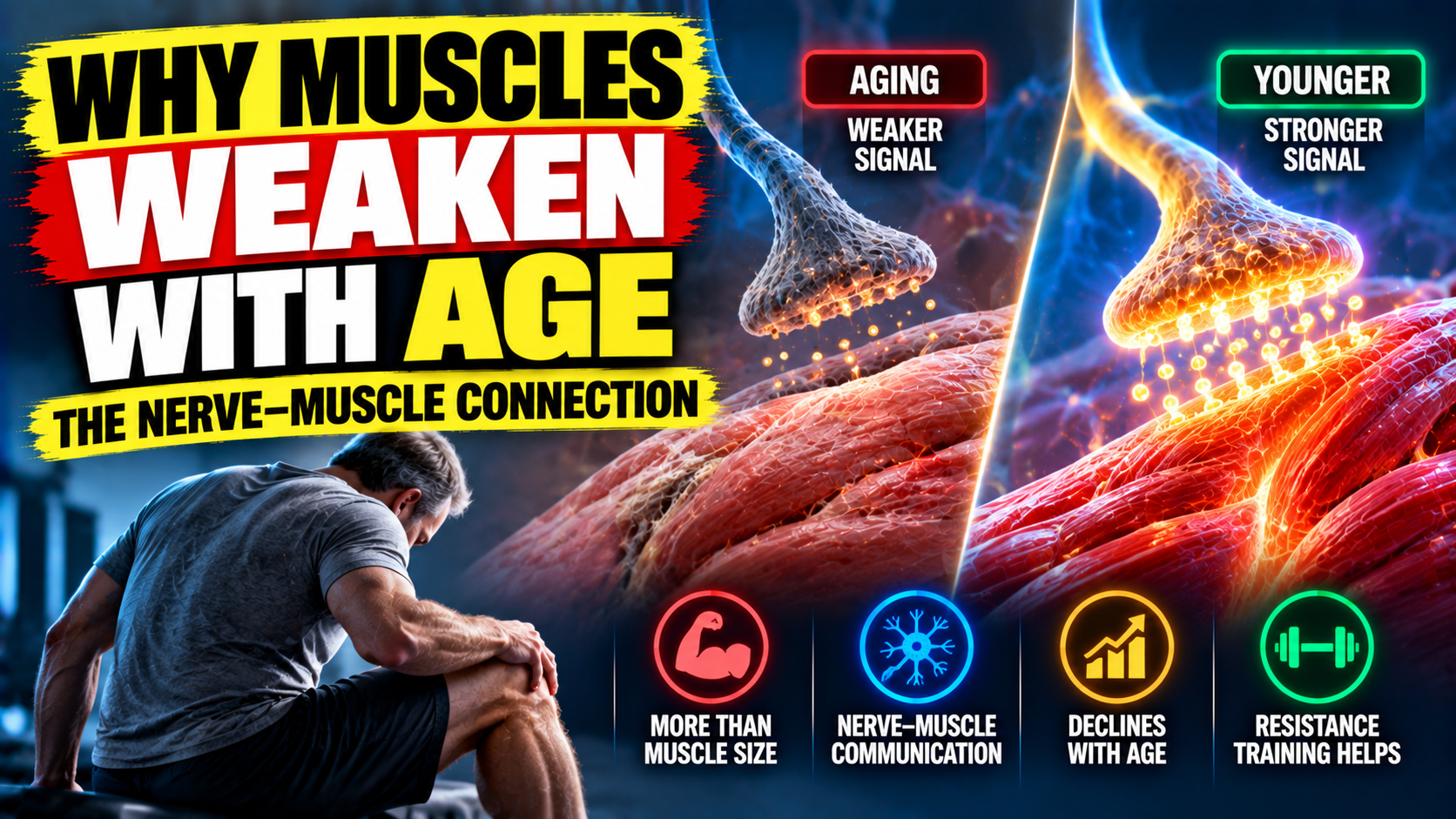
Muscle weakness with age may involve more than losing muscle size. New research suggests that communication between nerves and muscle fibers can become less reliable, with changes at the neuromuscular junction potentially contributing to sarcopenia and declining strength.
𝗞𝗘𝗬 𝗕𝗘𝗡𝗘𝗙𝗜𝗧𝗦
• Explains why strength can decline beyond muscle loss • Introduces the neuromuscular junction • Shows the role of NaV1.4 in muscle activation • Explains why ClC-1 is an interesting research target • Separates promising animal research from human treatment
𝗧𝗛𝗘 𝗡𝗘𝗥𝗩𝗘–𝗠𝗨𝗦𝗖𝗟𝗘 𝗖𝗢𝗡𝗡𝗘𝗖𝗧𝗜𝗢𝗡
Every voluntary movement depends on communication between the nervous system and muscle.
The neuromuscular junction (NMJ) is the specialized connection where a motor nerve signals a muscle fiber to contract. If that signal becomes unreliable, a muscle may have difficulty producing force even when the muscle itself has not completely disappeared.
Earlier research has already suggested that age-related changes in the nervous system contribute substantially to muscle weakness.
𝗪𝗛𝗔𝗧 𝗧𝗛𝗘 𝗡𝗘𝗪 𝗥𝗘𝗦𝗘𝗔𝗥𝗖𝗛 𝗙𝗢𝗨𝗡𝗗
Researchers studying older adults found that weaker individuals had more evidence of NMJ transmission failure, and the severity of this failure was associated with muscle weakness.
They also identified reduced levels of the voltage-gated sodium channel NaV1.4 around the NMJ in older human muscle.
NaV1.4 helps skeletal muscle fibers generate and propagate electrical signals needed for contraction. A reduction at the NMJ may therefore reduce the reliability of nerve-to-muscle communication.
𝗪𝗛𝗘𝗥𝗘 𝗖𝗟𝗖–𝟭 𝗖𝗢𝗠𝗘𝗦 𝗜𝗡
The researchers then tested whether changing muscle excitability could improve the problem.
In aged rodents, partially inhibiting the chloride channel ClC-1 improved muscle excitability, neuromuscular transmission and muscle function.
That is an important experimental result—but it happened in animals.
It does not establish that a ClC-1-targeting treatment is safe or effective for older people.
𝗪𝗛𝗬 𝗧𝗛𝗜𝗦 𝗠𝗔𝗧𝗧𝗘𝗥𝗦
The findings add another layer to the way scientists understand age-related weakness.
Muscle aging is not simply a story of shrinking muscle fibers. Neural activation, muscle quality and communication between nerves and muscle can all influence strength.
That may help explain why two people with similar amounts of muscle can have very different levels of strength and physical function.
𝗪𝗛𝗔𝗧 𝗜𝗧 𝗠𝗘𝗔𝗡𝗦 𝗙𝗢𝗥 𝗠𝗘𝗡 𝟯𝟱+
There is no ClC-1 treatment that MEN35 readers should attempt to obtain or self-experiment with based on this research.
The practical message is much simpler: preserve strength before significant weakness develops.
Resistance training remains one of the best-supported tools for maintaining muscle strength and physical function with age. A 2025 systematic review and meta-analysis of 24 randomized trials involving 951 older adults with sarcopenia found that resistance training improved measures including handgrip strength, gait speed, knee-extension strength and functional performance.
WHO also recommends muscle-strengthening activity involving major muscle groups on at least two days per week.
𝗧𝗛𝗘 𝗥𝗘𝗦𝗘𝗔𝗥𝗖𝗛 𝗗𝗢𝗘𝗦 𝗡𝗢𝗧 𝗦𝗔𝗬
The study does not show that:
• ClC-1 inhibition is a treatment for sarcopenia in humans • NaV1.4 supplements can prevent age-related weakness • muscle weakness is caused by one mechanism • resistance training directly prevents NMJ transmission failure • a drug targeting ClC-1 is ready for consumer use
The human findings identify an important biological mechanism; the treatment experiments remain preclinical.
𝗠𝗘𝗡𝟯𝟱 𝗧𝗔𝗞𝗘𝗔𝗪𝗔𝗬
Strength is more than muscle size.
As researchers learn more about the nerve–muscle connection, the picture of aging muscle is becoming more sophisticated. For now, the strongest practical strategy remains maintaining strength and function through consistent resistance training.
𝗧𝗛𝗘 𝗕𝗢𝗧𝗧𝗢𝗠 𝗟𝗜𝗡𝗘
Aging may weaken the communication system that tells muscle to contract—not just the muscle itself.
The ClC-1 finding is an intriguing potential therapeutic direction, but it is still preclinical. For men 35+, the actionable lesson is to build and preserve strength rather than wait for future therapies.
For informational purposes only. This is not medical advice — consult a doctor before changing medication, supplements or training.