Anti-aging · Study
Photoaging and Damaged Mitochondria: A New Clue From Preclinical Research
Clearing Damaged Mitochondria to Fight Skin Photoaging” — September 17, 2026. · 01/10/2026 · added by men35 desk
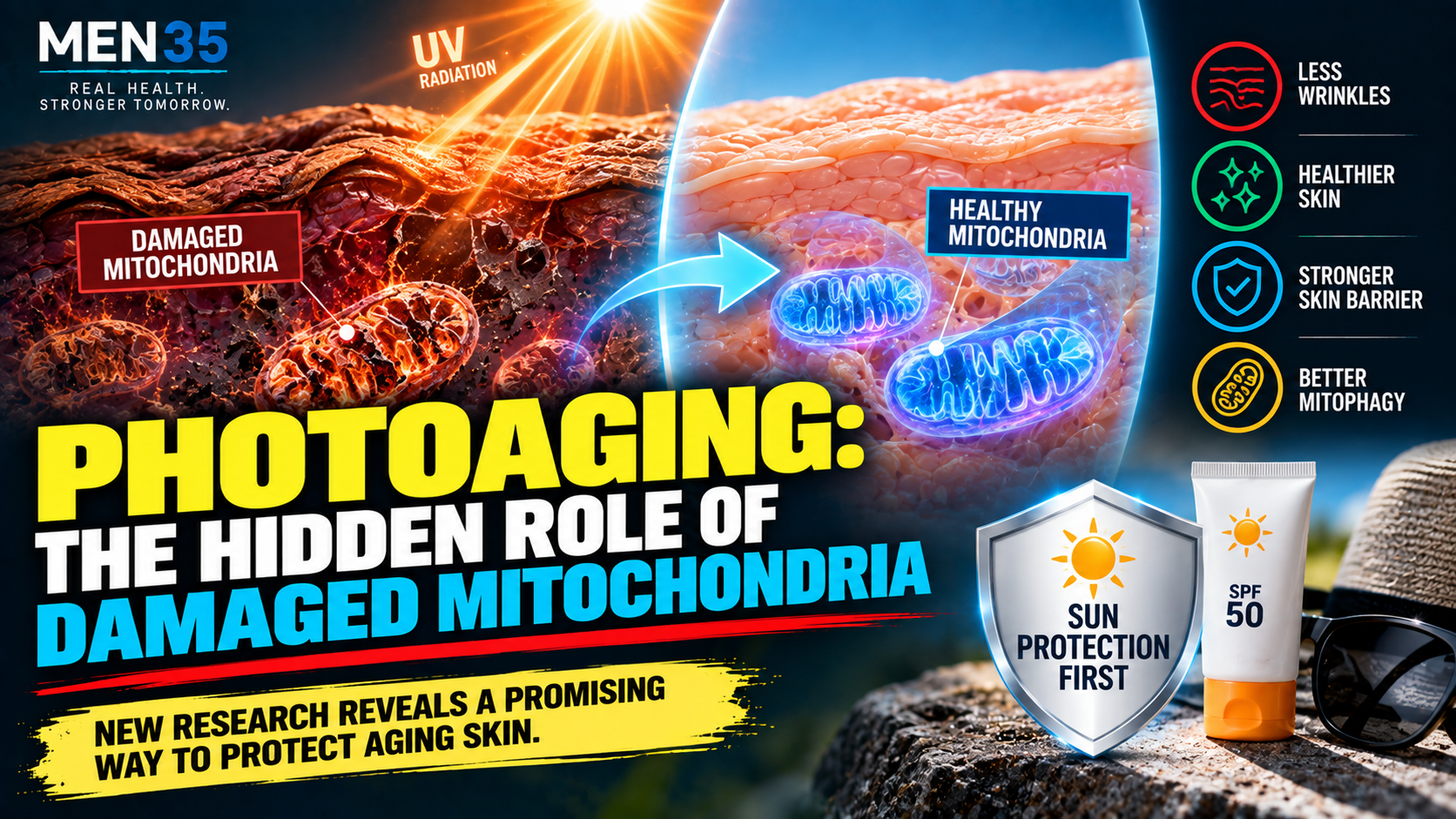
Sun exposure does more than create wrinkles. New research suggests that UV radiation can disrupt mitochondrial quality control in skin cells, contributing to inflammation and photoaging. In mice, a stem-cell-derived secretome improved these changes by increasing mitophagy—the process cells use to remove damaged mitochondria. The finding is promising, but it is not yet a human skincare treatment.
𝗞𝗘𝗬 𝗕𝗘𝗡𝗘𝗙𝗜𝗧𝗦
• Explains how UV exposure damages skin beyond surface wrinkles • Introduces mitophagy and mitochondrial quality control • Shows what the new mouse research actually found • Separates promising laboratory science from proven skincare • Reinforces the most established strategy: reducing UV exposure
𝗧𝗛𝗘 𝗦𝗨𝗡 𝗗𝗢𝗘𝗦 𝗠𝗢𝗥𝗘 𝗧𝗛𝗔𝗡 𝗖𝗥𝗘𝗔𝗧𝗘 𝗪𝗥𝗜𝗡𝗞𝗟𝗘𝗦
Chronic ultraviolet exposure is a major driver of extrinsic skin aging.
UV radiation can generate oxidative stress, damage cellular structures and promote inflammatory and senescence-related processes. Over time, this contributes to changes in collagen, skin elasticity, hydration and overall skin appearance.
The new study looked deeper—at what happens to mitochondria inside skin cells.
𝗪𝗛𝗬 𝗗𝗔𝗠𝗔𝗚𝗘𝗗 𝗠𝗜𝗧𝗢𝗖𝗛𝗢𝗡𝗗𝗥𝗜𝗔 𝗠𝗔𝗧𝗧𝗘𝗥
Mitochondria are responsible for much of a cell's energy production, but damaged mitochondria can also contribute to cellular stress and inflammatory signaling.
Cells have a quality-control process called mitophagy that helps identify and remove dysfunctional mitochondria.
The researchers found that UV exposure impaired this mitochondrial-cleanup process in their experimental models.
𝗪𝗛𝗔𝗧 𝗧𝗛𝗘 𝗡𝗘𝗪 𝗦𝗧𝗨𝗗𝗬 𝗙𝗢𝗨𝗡𝗗
Published in Aging Cell in September 2026, the study tested a secretome—a mixture of molecules released by human umbilical-cord mesenchymal stem cells.
In UV-exposed mice, the treatment improved several measured features of photoaging, including epidermal barrier function and dermal collagen integrity.
Experiments in human immortalized keratinocytes produced similar cellular findings.
The researchers linked the effect to enhanced mitophagy. By improving clearance of damaged mitochondria, the treatment reduced mitochondrial-DNA leakage and dampened activation of the cGAS-STING inflammatory pathway.
When the researchers blocked mitophagy, the protective effects were substantially reduced.
𝗧𝗛𝗜𝗦 𝗜𝗦 𝗡𝗢𝗧 𝗔 𝗡𝗘𝗪 𝗔𝗡𝗧𝗜-𝗔𝗚𝗜𝗡𝗚 𝗖𝗥𝗘𝗔𝗠
This distinction matters.
The study did not test an ordinary cosmetic cream, vitamin, supplement or consumer skincare product in humans.
The experimental treatment was a complex secretome derived from human umbilical-cord mesenchymal stem cells, tested in mice and laboratory cells.
The authors themselves state that the findings require further clinical validation. Human skin is also biologically different from mouse skin, and the study cannot establish long-term safety or effectiveness in people.
So a skincare product containing an antioxidant, peptide or other ingredient should not be described as reproducing these results simply because it claims to support mitochondrial health.
𝗧𝗛𝗘 𝗣𝗥𝗔𝗖𝗧𝗜𝗧𝗜𝗖𝗔𝗟 𝗟𝗘𝗦𝗦𝗢𝗡 𝗙𝗢𝗥 𝗠𝗘𝗡𝟯𝟱
The most useful takeaway is actually much less futuristic.
If UV exposure is a major driver of photoaging, reducing cumulative UV damage remains the foundation of prevention.
That means:
• Use broad-spectrum sunscreen appropriately • Reapply when needed, particularly during prolonged outdoor exposure • Use shade and protective clothing when practical • Avoid intentional tanning • Treat sun protection as a daily habit, not something reserved for beach days
Experimental research into mitochondrial repair is exciting—but preventing repeated UV damage is already actionable.
𝗪𝗛𝗘𝗥𝗘 𝗦𝗞𝗜𝗡𝗖𝗔𝗥𝗘 𝗙𝗜𝗧𝗦
For men 35+, the sensible skincare strategy is to separate established protection from emerging biology.
Sun protection has a clear role in preventing UV-related skin damage.
Other skincare ingredients may have evidence for particular cosmetic or dermatological outcomes, but their claims should be judged individually rather than by association with an experimental mitochondrial pathway.
The new study gives researchers a possible future target.
It does not give consumers a new anti-aging ingredient.
𝗠𝗘𝗡𝟯𝟱 𝗧𝗔𝗞𝗘𝗔𝗪𝗔𝗬
Your skin has its own mitochondrial quality-control system.
New mouse research suggests that restoring this system may reduce some biological effects of UV-induced photoaging.
But the intervention remains preclinical.
For men over 35, the proven strategy is still straightforward: protect your skin from UV exposure first.
𝗧𝗛𝗘 𝗕𝗢𝗧𝗧𝗢𝗠 𝗟𝗜𝗡𝗘
Damaged mitochondria may be an important part of the biology behind photoaging.
The new research gives scientists a potential target—mitophagy—but it does not yet give consumers a validated mitochondrial anti-aging treatment.
The smartest move today is still prevention: reduce UV exposure and choose skincare based on human evidence rather than futuristic laboratory claims.
For informational purposes only. This is not medical advice — consult a doctor before changing medication, supplements or training.