Mind · Study
Mental Fatigue vs Sleepiness: Why Your Tired Brain May Need Something Different
Frontiers in Neuroergonomics, October 6 · 20/10/2026 · added by men35 desk
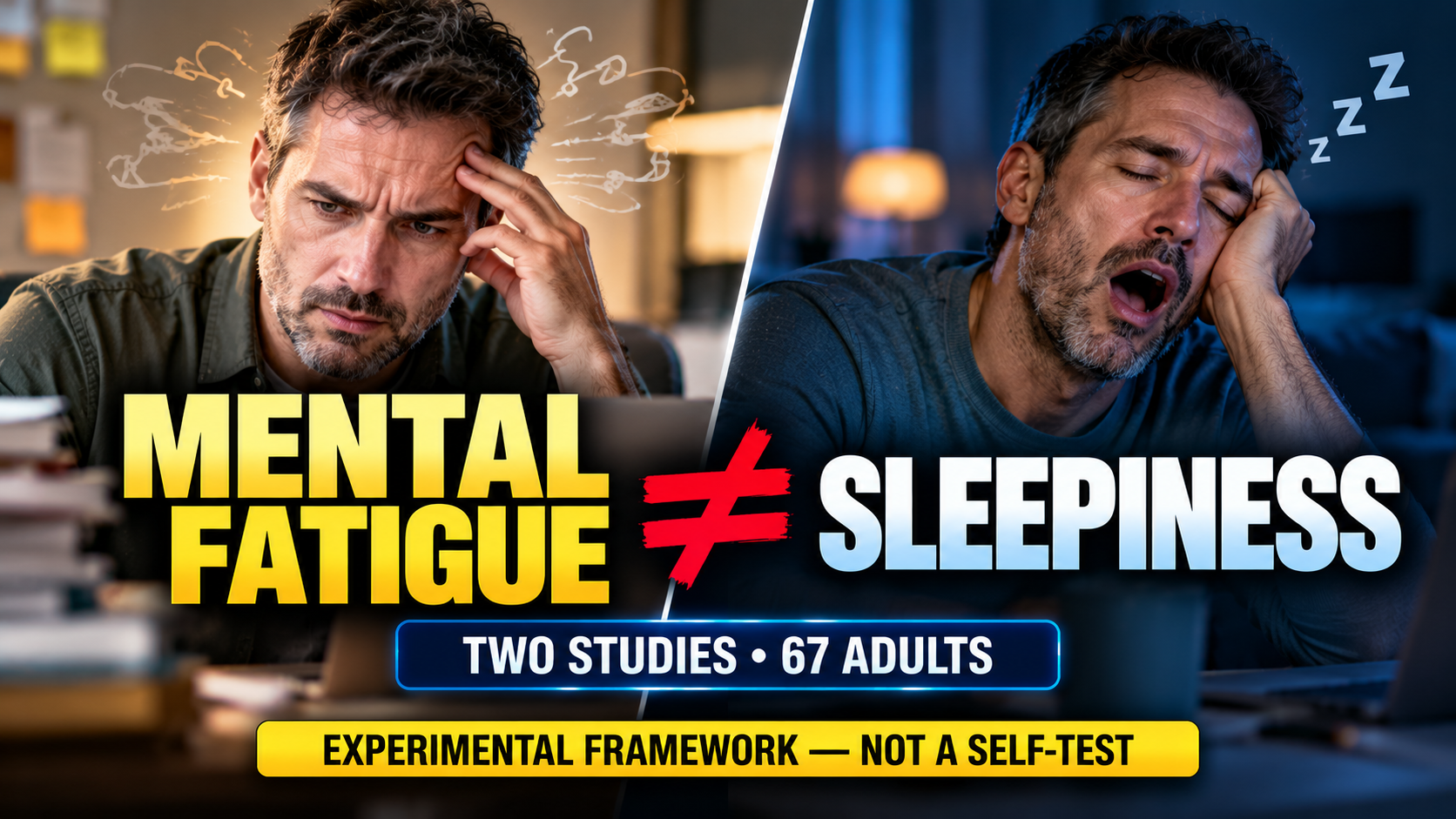
Feeling mentally drained is not necessarily the same as being sleepy. Two experiments involving 67 adults suggest that demanding tasks and restricted sleep can produce different patterns of fatigue, drowsiness and attention lapses. Understanding the distinction may help men over 35 think more clearly about work, recovery and performance.
KEY BENEFITS
Understand two different signals: Mental fatigue and sleepiness can overlap without being identical.
Recognise workload effects: Difficult tasks can increase perceived mental effort and fatigue.
Understand sleep restriction: Reduced sleep can increase drowsiness and mind-wandering.
Make better recovery decisions: Consider both workload and sleep when assessing how you feel.
Avoid misleading self-diagnosis: These findings are a research framework, not a personal diagnostic test.
𝗧𝗪𝗢 𝗞𝗜𝗡𝗗𝗦 𝗢𝗙 𝗧𝗜𝗥𝗘𝗗
You finish a demanding workday. Your head feels overloaded, concentrating takes effort, and even a simple decision seems difficult.
But are you sleepy—or mentally exhausted?
The distinction matters. You might feel drained after hours of intense concentration without feeling ready to fall asleep. Alternatively, after a short night, you might struggle to stay alert even when your workload is manageable.
A study published in Frontiers in Neuroergonomics on October 6, 2026, investigated how task demands and sleep restriction affect these related but distinct mental states. The researchers proposed an experimental framework for distinguishing them during operational work. <Cite refs={["turn885008search1","turn885008search2"]}/>
𝗪𝗛𝗔𝗧 𝗧𝗛𝗘 𝗧𝗪𝗢 𝗘𝗫𝗣𝗘𝗥𝗜𝗠𝗘𝗡𝗧𝗦 𝗙𝗢𝗨𝗡𝗗
The research involved two small experiments: one with 40 participants and another with 27 healthy adults.
Researchers varied task difficulty and examined the effects of partial sleep restriction. They assessed experiences such as perceived workload, fatigue, drowsiness and mind-wandering.
The reported pattern was revealing:
Harder tasks: Increased perceived workload and mental fatigue.
Restricted sleep: More clearly increased drowsiness and mind-wandering.
These findings suggest that the brain's response to demanding work is not identical to its response to insufficient sleep. The states can overlap, but they should not automatically be treated as interchangeable. <Cite refs={["turn885008search1","turn885008search2"]}/>
𝗪𝗛𝗬 𝗧𝗛𝗜𝗦 𝗠𝗔𝗧𝗧𝗘𝗥𝗦 𝗔𝗙𝗧𝗘𝗥 𝟯𝟱
For men balancing careers, family responsibilities, training and other commitments, tiredness can become a routine part of life.
But the cause matters. A mentally demanding day may leave you feeling overloaded, while inadequate sleep can make you drowsy and more prone to losing focus. Both may affect performance, and neither should be dismissed simply because you can still push through.
The practical lesson is not to label every difficult day as sleep deprivation—or assume that feeling alert means you have had enough sleep.
Instead, pay attention to the circumstances: how much you slept, how demanding your day has been, whether you are struggling to stay awake, and whether your attention keeps drifting.
𝗔 𝗨𝗦𝗘𝗙𝗨𝗟 𝗗𝗜𝗦𝗧𝗜𝗡𝗖𝗧𝗜𝗢𝗡—𝗡𝗢𝗧 𝗔 𝗦𝗘𝗟𝗙-𝗧𝗘𝗦𝗧
These experiments provide a framework for studying mental states, particularly in work settings where attention and performance matter.
They do not establish a reliable way to diagnose yourself based on how tired you feel. The sample sizes were small, and individual experiences can overlap. Nor do the findings mean that mental fatigue can always be separated neatly from sleepiness in everyday life.
If you are persistently sleepy despite adequate sleep, or experience ongoing fatigue that interferes with daily life, consider discussing it with a healthcare professional. Sleep disorders, medical conditions, medications and other factors may contribute.
𝗠𝗘𝗡𝟯𝟱 𝗧𝗔𝗞𝗘𝗔𝗪𝗔𝗬
Ask yourself two separate questions: “Has my workload mentally drained me?” and “Am I struggling to stay awake because I may not have slept enough?”
Neither question gives you a diagnosis. But recognising that these are different experiences can help you reflect more carefully on your workload, sleep and recovery.
𝗕𝗢𝗧𝗧𝗢𝗠 𝗟𝗜𝗡𝗘
Mental exhaustion and sleepiness are related, but not interchangeable. In two small experiments, demanding tasks more strongly increased perceived workload and fatigue, while partial sleep restriction more clearly increased drowsiness and mind-wandering. The framework is promising for research—not a diagnostic self-test.
For informational purposes only. This is not medical advice — consult a doctor before changing medication, supplements or training.