Health · News
Put the Stopwatch Away: What Is Normal for Men’s Sexual Health?
Harvard Health, October 8 · 15/10/2026 · added by men35 desk
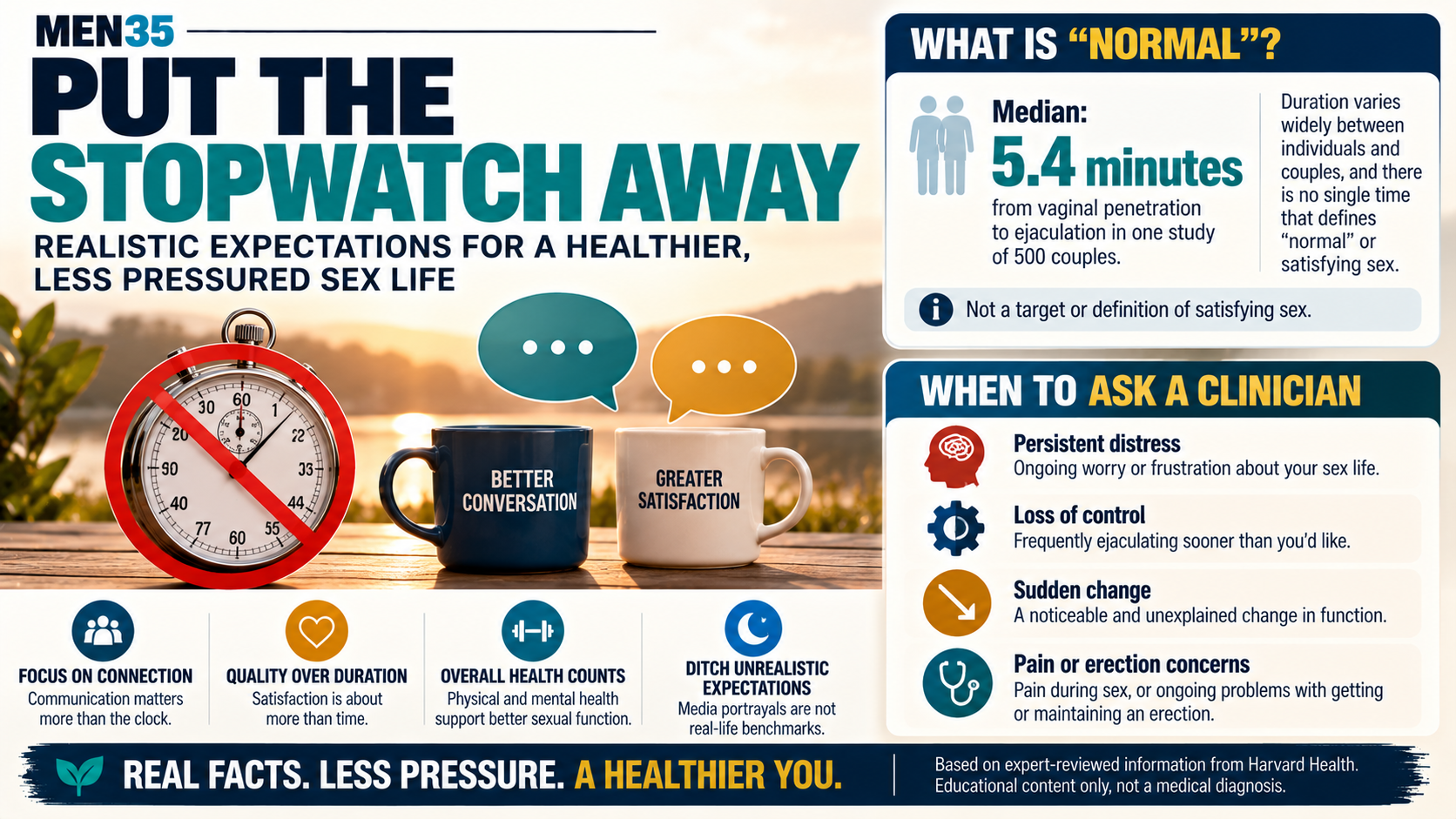
Many men judge their sexual performance against unrealistic expectations shaped by pornography, social media and locker-room talk. Harvard Health’s physician-reviewed explainer offers a more grounded perspective: sexual duration varies, and a stopwatch cannot measure satisfaction, intimacy or sexual health. For men over 35, the better approach is to understand what research actually says—and when a concern deserves a conversation with a clinician.
KEY BENEFITS
Understand what research says about typical intercourse duration.
Separate realistic expectations from media-driven performance pressure.
Recognise when ejaculation concerns may warrant professional advice.
Focus on communication, satisfaction and sexual wellbeing rather than a target time.
𝐓𝐇𝐄 𝐌𝐘𝐓𝐇 𝐎𝐅 𝐓𝐇𝐄 𝐏𝐄𝐑𝐅𝐄𝐂𝐓 𝐓𝐈𝐌𝐄
There is no universal duration that makes sex “normal” or satisfying.
Harvard Health’s October 8, 2026, article, How long should sex last?, reports that research suggests the median time from vaginal penetration to ejaculation is around five to six minutes. That figure is a population statistic—not a performance target or a measure of sexual quality.
A frequently cited multinational study of 500 couples found a median of 5.4 minutes, with substantial variation between individuals. Importantly, the study measured the time from vaginal penetration to ejaculation. It did not measure the entire sexual experience, foreplay, intimacy or whether both partners felt satisfied.
A research average is not a rule you have to meet.
𝐖𝐇𝐀𝐓 𝐈𝐒 “𝐍𝐎𝐑𝐌𝐀𝐋”?
Sexual experiences vary with desire, arousal, stress, relationship dynamics, health and personal preferences. Some encounters are brief; others take longer. Duration can also vary for the same person from one occasion to another.
The Harvard Health explainer notes that premature ejaculation is loosely associated with ejaculation in under two minutes. But a number alone is not enough to diagnose a sexual problem. Clinicians also consider whether ejaculation happens consistently sooner than desired, whether control feels limited, and whether the situation causes significant distress.
The broader lesson is to avoid turning a single measurement into a verdict about masculinity or health.
𝐓𝐇𝐄 𝐂𝐑𝐈𝐓𝐈𝐂𝐀𝐋-𝐓𝐇𝐈𝐍𝐊𝐈𝐍𝐆 𝐁𝐎𝐗
WHAT IS “NORMAL”—AND WHEN IS IT WORTH ASKING A CLINICIAN?
Keep expectations realistic. A median of about five minutes in one study does not mean every man should last that long—or that longer is automatically better.
Look at the whole experience. Mutual comfort, communication, pleasure and satisfaction matter more than timing alone.
Seek advice when a problem persists. Consider talking to a clinician if you regularly ejaculate sooner than you want and feel unable to control it, if sexual difficulties are causing distress, or if you or your partner are worried about the effect on your relationship.
Pay attention to changes. New or persistent erection difficulties, pain during sex, a marked unexplained change in sexual function or other concerning symptoms deserve medical attention.
This is educational guidance, not a diagnostic checklist. You do not need to wait until a problem becomes severe before discussing it with a healthcare professional.
𝐖𝐇𝐘 𝐌𝐄𝐍 𝟑𝟓+ 𝐒𝐇𝐎𝐔𝐋𝐃 𝐓𝐀𝐊𝐄 𝐓𝐇𝐄 𝐏𝐑𝐄𝐒𝐒𝐔𝐑𝐄 𝐎𝐅𝐅
Sexual function can be influenced by physical health, mental wellbeing, medications, stress and relationship factors. Persistent erectile difficulties, for example, can sometimes be associated with conditions such as diabetes or cardiovascular disease, so they should not automatically be dismissed as an inevitable part of ageing.
At the same time, ordinary variation does not necessarily signal a medical problem. Worrying excessively about performance can make intimacy feel like a test rather than a shared experience.
A more useful approach is to communicate openly with your partner, pay attention to what feels satisfying for both of you, and seek medical advice when a persistent concern affects your wellbeing. Avoid unregulated “performance” supplements or prescription medicines obtained without appropriate medical guidance.
𝐌𝐄𝐍𝟑𝟓 𝐓𝐀𝐊𝐄𝐀𝐖𝐀𝐘
Sexual health is not a race against the clock. Research provides useful context, but no single duration defines good sex or personal worth. Focus on mutual satisfaction, realistic expectations and overall health—and seek professional help when a persistent problem causes distress.
𝐁𝐎𝐓𝐓𝐎𝐌 𝐋𝐈𝐍𝐄
Put the stopwatch away. The aim is not to hit a number; it is to have a satisfying, comfortable sexual experience. If a persistent change or difficulty is troubling you, a clinician can help you understand the cause and discuss appropriate options.
For informational purposes only. This is not medical advice — consult a doctor before changing medication, supplements or training.