Strength · Video
The MEN35 Bodybuilding Health Check: What Lifters Should Monitor After 35
YouTube — Renaissance Periodization · 07/10/2026 · added by men35 desk
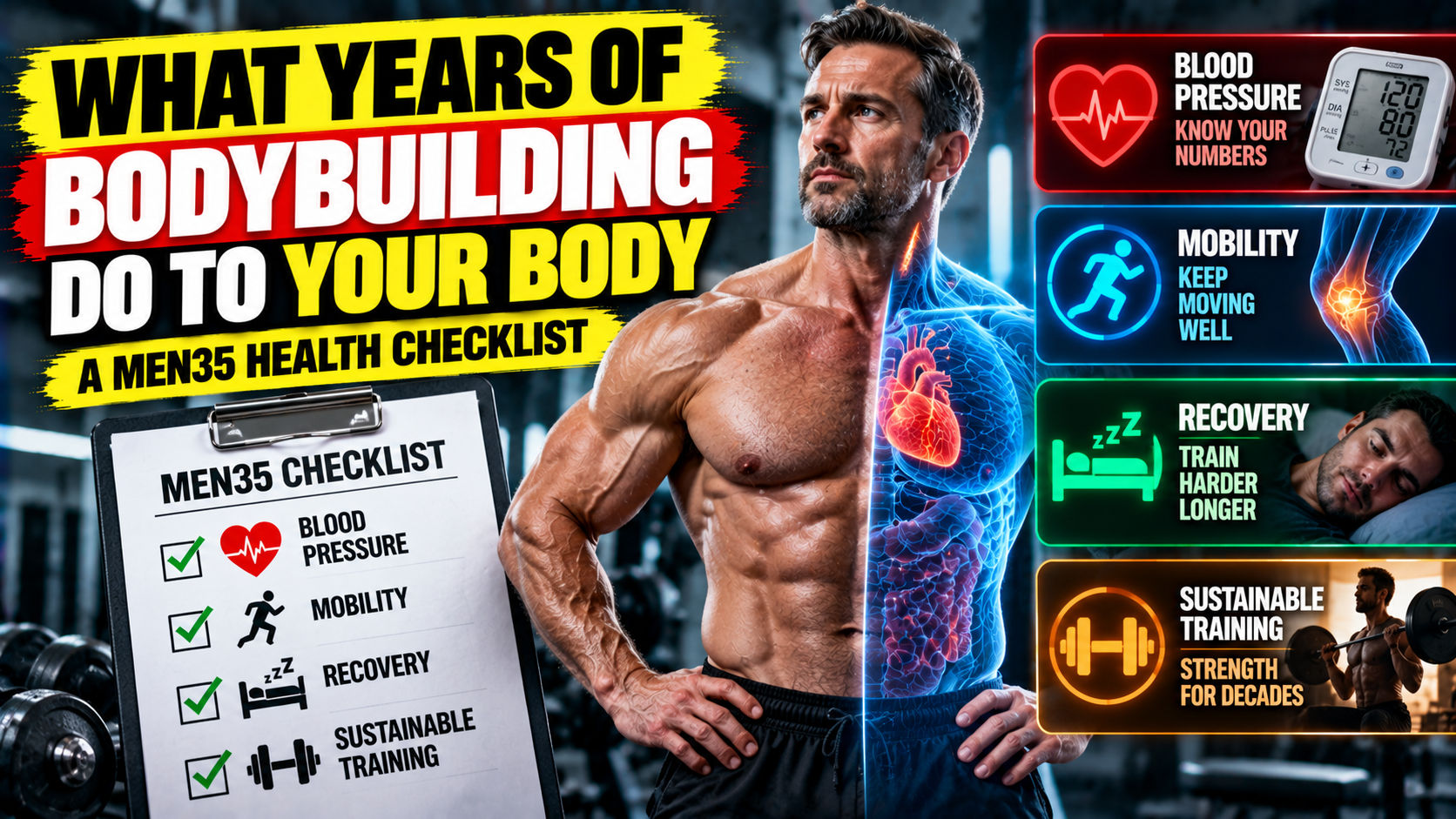
Years of lifting can build impressive muscle—but after 35, the smarter question is whether your training is still supporting your whole body. Here’s the MEN35 checklist for blood pressure, mobility, recovery and sustainable strength.
Key Benefits:
Shows what experienced lifters should monitor beyond muscle size.
Explains why blood pressure belongs in every serious fitness plan.
Provides a practical mobility and recovery check.
Helps distinguish productive training from training that is simply harder.
Reframes bodybuilding around strength and health that can last for decades.
𝗧𝗛𝗘 𝗕𝗢𝗗𝗬𝗕𝗨𝗜𝗟𝗗𝗜𝗡𝗚 𝗖𝗛𝗘𝗖𝗞
If you have spent years lifting, your body tells a much bigger story than your bench press or body-fat percentage.
Muscle mass is valuable, but long-term health requires more: cardiovascular health, movement quality, recovery capacity and the ability to keep training without accumulating problems.
That makes a periodic “body scan” useful as a concept—but the most useful scan for men 35+ is not a single machine or dramatic before-and-after image.
It is a checklist.
𝗖𝗛𝗘𝗖𝗞 𝟭 — 𝗕𝗟𝗢𝗢𝗗 𝗣𝗥𝗘𝗦𝗦𝗨𝗥𝗘
Being muscular or physically active does not automatically mean your blood pressure is healthy.
The 2025 American Heart Association/American College of Cardiology guideline classifies normal blood pressure as below 120/80 mm Hg, while readings of 130–139 systolic or 80–89 diastolic fall into stage 1 hypertension.
For men who train seriously, blood pressure is worth monitoring because it is a cardiovascular-health measure—not a bodybuilding metric.
A practical check:
☐ Know your recent blood-pressure readings ☐ Use a validated upper-arm cuff if monitoring at home ☐ Take repeated readings rather than judging yourself from one number ☐ Discuss persistently elevated readings with a healthcare professional
Home monitoring can help provide a more complete picture, but it does not replace medical assessment.
𝗖𝗛𝗘𝗖𝗞 𝟮 — 𝗠𝗢𝗩𝗘𝗕𝗜𝗟𝗜𝗧𝗬
Can you still move well—not just lift heavy?
Years of training should ideally leave you stronger without making basic movement increasingly difficult.
Check whether you can comfortably:
☐ Squat and stand without major restriction ☐ Reach overhead ☐ Rotate your upper body ☐ Hinge at the hips ☐ Walk briskly without unusual discomfort ☐ Get up from the floor ☐ Perform single-leg movements with reasonable control
This matters because resistance training can improve physical function as well as strength and muscle size. A large systematic review found that many resistance-training prescriptions improved strength and physical function, including mobility and gait-related outcomes.
The goal is not perfect flexibility.
The goal is to remain capable.
𝗖𝗛𝗘𝗖𝗞 𝟯 — 𝗥𝗘𝗖𝗢𝗩𝗘𝗥𝗬
One of the biggest mistakes experienced lifters can make is measuring progress only by how hard they can train.
Recovery is part of the training system.
Ask yourself:
☐ Am I sleeping at least seven hours most nights? ☐ Do I feel reasonably refreshed when I wake? ☐ Are aches accumulating rather than resolving? ☐ Is performance stable or gradually declining? ☐ Do I repeatedly need to train through excessive fatigue?
The CDC recommends at least seven hours of sleep for adults aged 18–60, while also emphasizing that sleep quality matters—not simply time in bed.
If performance repeatedly deteriorates while fatigue and poor sleep increase, the answer is not automatically another supplement or another training session.
Sometimes the program needs adjusting.
𝗖𝗛𝗘𝗖𝗞 𝟒 — 𝗦𝗨𝗦𝗧𝗔𝗜𝗡𝗔𝗕𝗟𝗘 𝗧𝗥𝗔𝗜𝗡𝗜𝗡𝗚
The best training program after 35 is not necessarily the program that produces the most exhaustion.
It is the program you can execute consistently while maintaining health, strength and function.
The American College of Sports Medicine's 2026 resistance-training position stand reviewed evidence from more than 137 studies involving more than 30,000 participants and examined outcomes including strength, hypertrophy, power, endurance and physical function.
The broader evidence also shows that there is no single magical resistance-training prescription. Different combinations of load, sets and frequency can produce meaningful improvements.
For long-term lifters, that creates an important principle:
You don't need to train maximally to train effectively.
Progressive overload matters. So do exercise selection, technique, recovery and consistency.
𝗖𝗛𝗘𝗖𝗞 𝟓 — 𝗖𝗔𝗥𝗗𝗜𝗢 𝗪𝗜𝗧𝗛 𝗧𝗛𝗘 𝗠𝗨𝗦𝗖𝗟𝗘
A bodybuilding-focused routine should not completely neglect cardiovascular fitness.
WHO recommends adults accumulate 150–300 minutes of moderate aerobic activity or 75–150 minutes of vigorous activity each week, alongside muscle-strengthening work on at least two days.
For a serious lifter, this does not mean abandoning strength training.
It means building a more complete physical base.
Walking, cycling, swimming, running or other aerobic activity can complement resistance training rather than compete with it.
𝗧𝗛𝗘 𝗥𝗘𝗔𝗟 𝗕𝗢𝗗𝗬𝗕𝗨𝗜𝗟𝗗𝗜𝗡𝗚 𝗦𝗖𝗢𝗥𝗘𝗖𝗔𝗥𝗗
Instead of asking only, “How muscular am I?”, men 35+ should periodically ask:
☐ Is my blood pressure under control? ☐ Can I move through everyday ranges comfortably? ☐ Am I recovering between sessions? ☐ Am I sleeping well? ☐ Is my strength stable or improving? ☐ Can I perform aerobic activity without excessive limitation? ☐ Can I keep following my program for another five, ten or twenty years?
That is a much more useful definition of being “in shape.”
𝗪𝗛𝗔𝗧 𝗔 𝗕𝗢𝗗𝗬 𝗦𝗖𝗔𝗡 𝗖𝗔𝗡𝗧 𝗧𝗘𝗟𝗟 𝗬𝗢𝗨
A body-composition scan, fitness test or dramatic transformation can provide useful information.
But none should be treated as a complete medical assessment.
A scan cannot by itself diagnose cardiovascular disease, determine whether an injury is present, establish your recovery needs or tell you whether a particular training program is appropriate.
For those questions, clinical history, physical examination and appropriate testing still matter.
𝗠𝗘𝗡𝟯𝟱 𝗧𝗔𝗞𝗘𝗔𝗪𝗔𝗬
After 35, successful bodybuilding is less about proving how much punishment you can tolerate and more about preserving what you have built.
Track your blood pressure. Protect mobility. Take recovery seriously. Keep some aerobic fitness in the program. And choose a training structure you can sustain.
The strongest body is not necessarily the one that looks the most impressive today.
It is the one that still works exceptionally well years from now.
𝗧𝗛𝗘 𝗕𝗢𝗧𝗧𝗢𝗠 𝗟𝗜𝗡𝗘
A bodybuilding “body scan” can be entertaining, but your real health scorecard is broader.
For men 35+, muscle is only one part of the equation.
Strength + cardiovascular health + mobility + recovery + consistency is the better long-term target.
For informational purposes only. This is not medical advice — consult a doctor before changing medication, supplements or training.