Longevity · Study
SEMAGLUTIDE AND LONGEVITY: WHAT A 12.4% LIFESPAN INCREASE IN MICE REALLY MEANS
“Late-Life GLP-1 Treatment Increases Lifespan in Female Mice” · 01/10/2026 · added by men35 desk
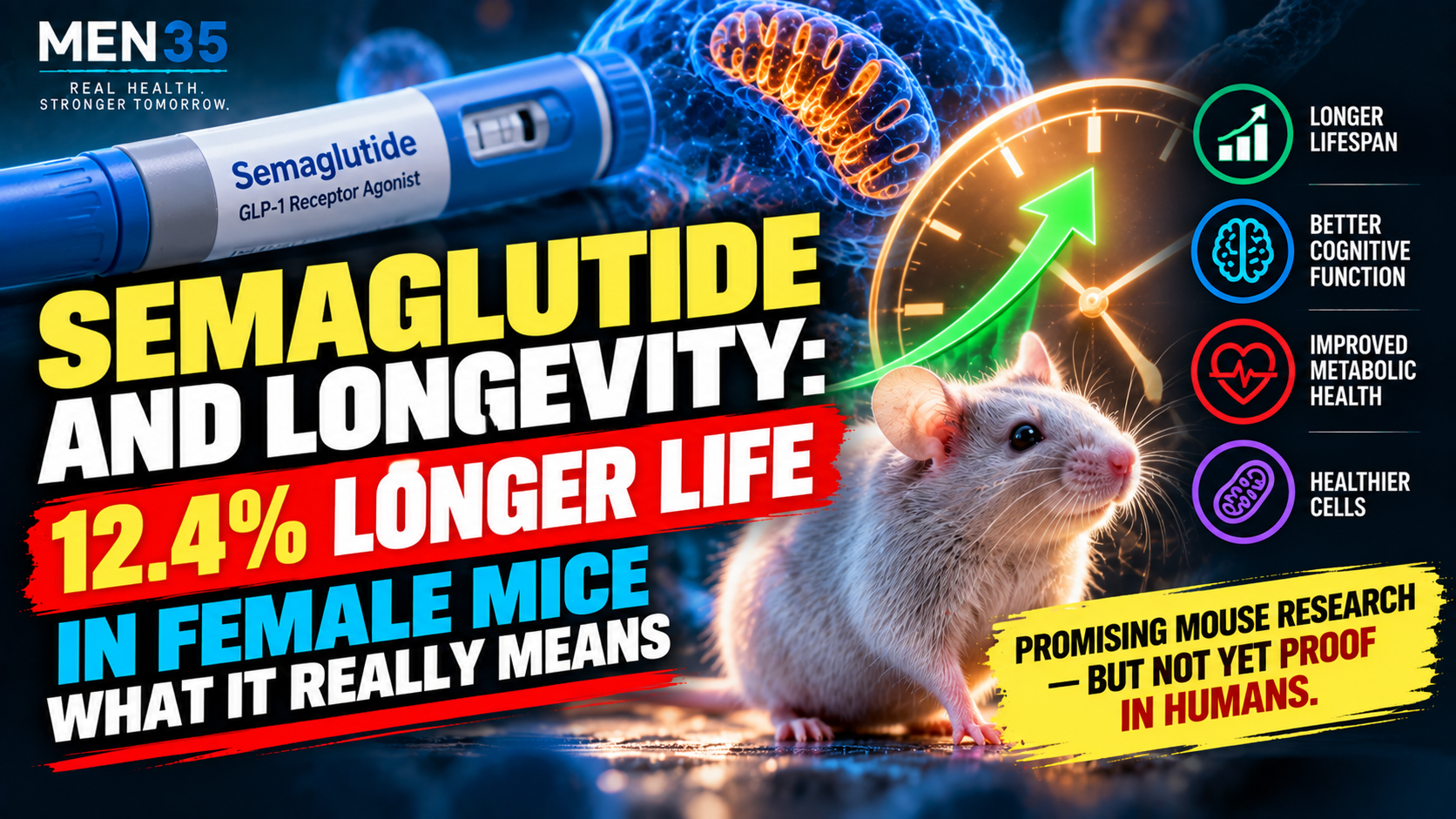
Could a drug developed for metabolic health also influence the biology of aging? A new study found that late-life semaglutide treatment extended median lifespan in female mice by 12.4% and improved several measures of physical, cognitive and metabolic function. The important question is whether any of these effects translate to humans. So far, that remains unproven.
𝗞𝗘𝗬 𝗕𝗘𝗡𝗘𝗙𝗜𝗧𝗦
• Explains what the new semaglutide longevity study found • Separates lifespan findings from human clinical evidence • Examines the relationship between semaglutide and calorie restriction • Explains why GLP-1 biology is attracting longevity researchers • Shows what men 35+ should—and should not—take from the study
𝗙𝗥𝗢𝗠 𝗪𝗘𝗜𝗚𝗛𝗧 𝗟𝗢𝗦𝗦 𝗧𝗢 𝗟𝗢𝗡𝗚𝗘𝗩𝗜𝗧𝗬
Semaglutide is a GLP-1 receptor agonist used clinically for conditions including obesity and type 2 diabetes.
Its established effects include reducing appetite, lowering food intake and improving glucose regulation.
Researchers are now asking a broader question: could GLP-1 signaling influence some of the biological processes associated with aging?
A 2026 study published in Nature provides an intriguing animal-model answer.
𝗧𝗛𝗘 𝟭𝟮.𝟰% 𝗟𝗜𝗙𝗘𝗦𝗣𝗔𝗡 𝗙𝗜𝗡𝗗𝗜𝗡𝗚
Researchers treated 20-month-old female C57BL/6 mice with semaglutide.
For the lifespan experiment, treatment continued until the animals died naturally or reached predefined humane endpoints.
Median lifespan was:
• 742 days in the control group • 834 days in the semaglutide group
That represents a difference of 92 days, or approximately 12.4% in median lifespan.
The finding is notable because treatment began relatively late in the animals' lives.
𝗜𝗧 𝗪𝗔𝗦 𝗡𝗢𝗧 𝗝𝗨𝗦𝗧 𝗔𝗕𝗢𝗨𝗧 𝗟𝗜𝗩𝗜𝗡𝗚 𝗟𝗢𝗡𝗚𝗘𝗥
The researchers also examined physical and cognitive function.
Compared with controls, semaglutide-treated mice showed improvements in several measurements, including exploratory activity, spatial memory, motor coordination and glucose regulation.
The researchers also reported changes in biological processes associated with aging, including inflammation, cellular senescence, mitochondrial function, proteostasis and DNA repair.
This distinction matters.
Longevity research increasingly looks at both lifespan and healthspan—not simply how long an organism survives, but how well it functions while aging.
𝗪𝗔𝗦 𝗜𝗧 𝗝𝗨𝗦𝗧 𝗖𝗔𝗟𝗢𝗥𝗜𝗘 𝗥𝗘𝗦𝗧𝗥𝗜𝗖𝗧𝗜𝗢𝗡?
This was one of the most interesting parts of the study.
Semaglutide reduces food intake, while calorie restriction is already known to extend lifespan in several animal models.
The researchers therefore compared semaglutide with approximately 24% calorie restriction in another group of older female mice.
Both approaches reduced food intake and produced several overlapping effects.
However, semaglutide produced some differences, including improvements in exploratory behavior, spatial memory and glucose control that were not observed to the same degree with calorie restriction.
The researchers interpreted the findings as evidence that GLP-1 receptor activation may have effects beyond simply making the animals eat less.
𝗪𝗛𝗔𝗧 𝗛𝗔𝗣𝗣𝗘𝗡𝗘𝗗 𝗜𝗡𝗦𝗜𝗗𝗘 𝗧𝗛𝗘 𝗠𝗜𝗖𝗘
The study found that semaglutide affected several biological pathways associated with aging.
These included pathways involved in:
• Inflammation • Cellular senescence • Mitochondrial stress • Proteostasis • DNA repair • Glucose and insulin signaling • Nutrient sensing
The researchers also observed changes in neural stem cells and neurogenesis in aged mice.
These findings provide possible mechanisms for further research, but they do not establish which mechanisms would be responsible for any potential effects in humans.
𝗧𝗛𝗘 𝗕𝗜𝗚 𝗛𝗨𝗠𝗔𝗡 𝗖𝗔𝗩𝗘𝗔𝗧
This is where the headline needs context.
The experiment was conducted in female mice.
It did not test whether semaglutide extends human lifespan.
It did not establish an anti-aging indication.
It did not determine whether healthy people should take semaglutide for longevity.
And it did not establish a human dose or treatment duration for extending lifespan.
The Nature paper itself states that whether GLP-1 receptor activation changes aging trajectories and lifespan in humans will require long-term clinical studies specifically designed to evaluate aging-related outcomes.
NIH similarly notes that results from mice do not necessarily translate directly to humans and that additional research is needed.
𝗪𝗛𝗬 𝗧𝗛𝗜𝗦 𝗦𝗧𝗨𝗗𝗬 𝗠𝗔𝗧𝗧𝗘𝗥𝗦
The important discovery isn't that semaglutide has suddenly become a proven longevity drug.
The more interesting possibility is that GLP-1 signaling may influence multiple biological systems involved in aging.
The study suggests that metabolic signaling, appetite regulation and aging biology may be more closely connected than previously appreciated.
That gives researchers another pathway to investigate.
𝗧𝗛𝗘 𝗘𝗩𝗜𝗗𝗘𝗡𝗖𝗘 𝗟𝗔𝗗𝗗𝗘𝗥
Human clinical evidence: Semaglutide has established medical uses, including treatment of obesity and type 2 diabetes.
Human longevity evidence: There is currently no established evidence that semaglutide extends lifespan in healthy humans.
Animal longevity evidence: This study found extended median lifespan in older female mice.
Mechanistic evidence: The researchers identified changes in several pathways associated with aging.
The evidence therefore moves the scientific question forward—but it does not answer the human longevity question.
𝗪𝗛𝗔𝗧 𝗠𝗘𝗡𝟯𝟱+ 𝗦𝗛𝗢𝗨𝗟𝗗 𝗧𝗔𝗞𝗘 𝗙𝗥𝗢𝗠 𝗜𝗧
The wrong conclusion would be:
“Semaglutide makes humans live 12% longer.”
That has not been demonstrated.
The accurate conclusion is:
Semaglutide extended median lifespan in an experimental group of older female mice and improved several age-related functional measures. Researchers now need to determine whether comparable effects exist in humans.
For men 35+, semaglutide should be considered according to its established medical indications and under appropriate medical supervision—not as a proven longevity therapy.
𝗠𝗘𝗡𝟯𝟱 𝗧𝗔𝗞𝗘𝗔𝗪𝗔𝗬
A 12.4% increase in median lifespan is an important finding in a mouse longevity experiment.
But animal lifespan research is the beginning of the evidence pathway, not the end.
The real question is whether GLP-1 biology can meaningfully influence human aging without creating unacceptable risks.
𝗧𝗛𝗘 𝗕𝗢𝗧𝗧𝗢𝗠 𝗟𝗜𝗡𝗘
Semaglutide has entered a fascinating new area of longevity research.
In older female mice, it extended median lifespan and improved several measures of physical, cognitive and metabolic function.
For humans, however, the longevity claim remains unproven.
Interesting science? Yes.
Established human anti-aging treatment? Not yet.
For informational purposes only. This is not medical advice — consult a doctor before changing medication, supplements or training.