Longevity · News
What Would It Take to Test an Ageing-Targeting Treatment?
Lifespan.io, October 2 · 13/10/2026 · added by men35 desk
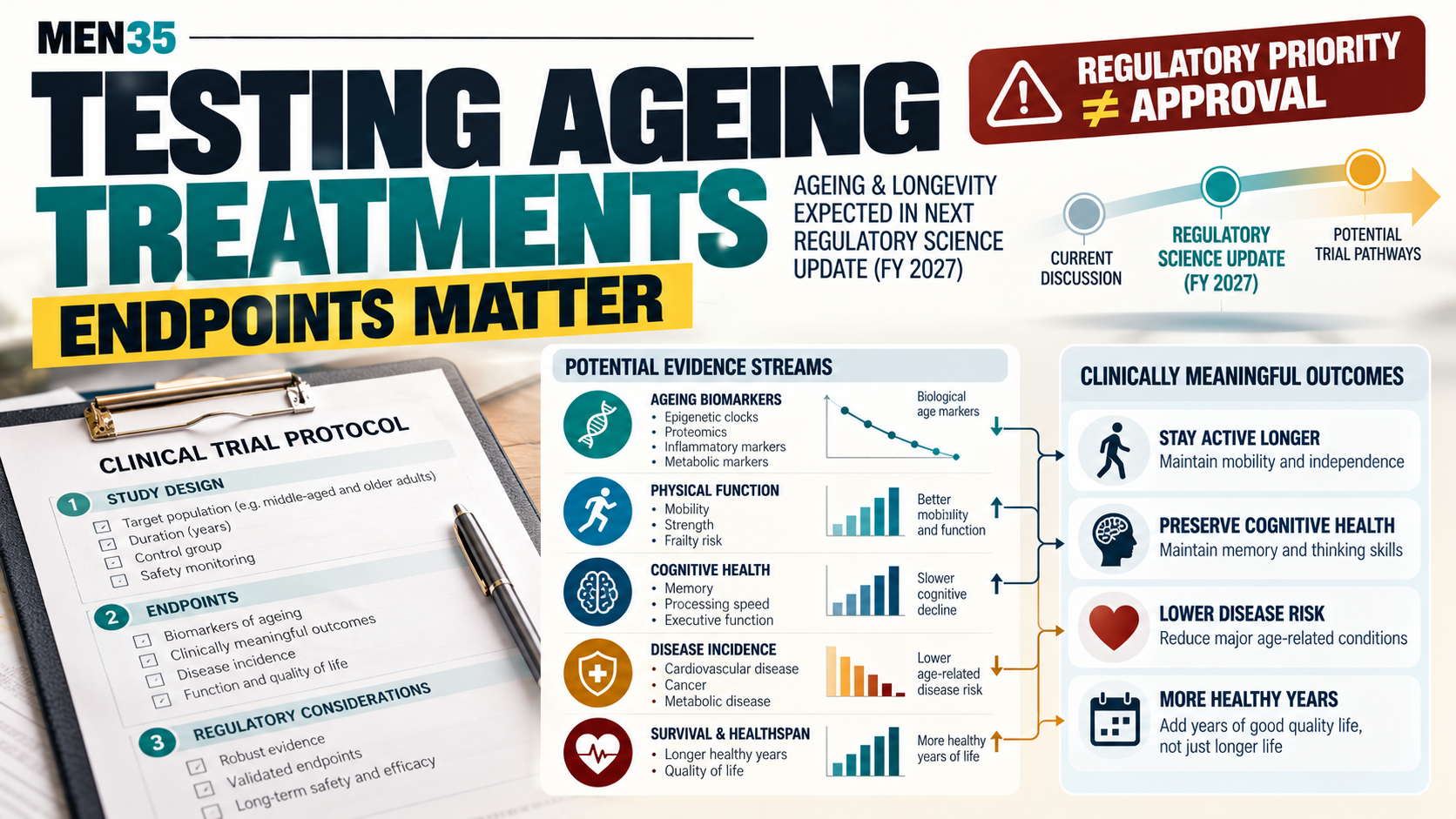
The FDA has signalled that ageing and longevity may feature in its next regulatory-science update. For men over 35, the bigger question is how researchers could prove that a treatment adds healthier years—not simply makes a biological-age test look younger.
KEY BENEFITS
Understand the FDA’s emerging focus on ageing research.
Learn why biological-age biomarkers are not enough to prove benefit.
Discover which clinical outcomes could matter in longevity trials.
See why safety, trial duration and meaningful results remain major hurdles.
𝐖𝐇𝐀𝐓 𝐓𝐇𝐄 𝐅𝐃𝐀 𝐒𝐈𝐆𝐍𝐀𝐋𝐋𝐄𝐃
At the October 2, 2026, Aging Research & Drug Discovery (ARDD) meeting, senior US Food and Drug Administration officials discussed how treatments targeting ageing might eventually be evaluated.
The key announcement: ageing and longevity are expected to feature in the agency’s next Focus Areas of Regulatory Science update, tentatively targeted for fiscal year 2027.
The discussion explored potential evidence and approval pathways. It did not announce approval of an anti-ageing drug or establish a new, confirmed approval pathway.
That distinction matters. Regulatory interest can encourage better research, but treatments still need convincing evidence of safety and effectiveness.
𝐓𝐇𝐄 𝐁𝐈𝐆 𝐂𝐇𝐀𝐋𝐋𝐄𝐍𝐆𝐄: 𝐏𝐑𝐎𝐕𝐈𝐍𝐆 𝐁𝐄𝐍𝐄𝐅𝐈𝐓
Ageing contributes to the risk of many chronic conditions, including cardiovascular disease, diabetes and some forms of cancer. Researchers therefore want to know whether an intervention could delay several age-related problems rather than target only one disease.
But how do you prove that a treatment slows ageing?
A biological-age test might estimate patterns in DNA methylation, proteins or other biomarkers. If the number improves after treatment, that is an interesting scientific signal—but it does not automatically mean the person will live longer, avoid disease or remain independent for longer.
A useful marker must be validated for the specific purpose it is intended to serve. In particular, researchers need evidence that a treatment-induced change in the marker reliably predicts a meaningful clinical benefit.
𝐖𝐇𝐀𝐓 𝐒𝐇𝐎𝐔𝐋𝐃 𝐓𝐑𝐈𝐀𝐋𝐒 𝐌𝐄𝐀𝐒𝐔𝐑𝐄?
Potential approaches discussed by FDA officials include two broad strategies:
1. Track multiple age-related conditions. Researchers could investigate whether a treatment reduces the occurrence or progression of several conditions associated with ageing. A benefit for one disease alone would not automatically prove a wider anti-ageing effect.
2. Measure how well people function. Trials could assess changes in physical and mental capabilities over time, sometimes described through the concept of intrinsic capacity. Relevant measures might include mobility, strength, cognitive performance and the ability to carry out everyday activities.
Depending on the treatment and trial, researchers may also need to examine serious health events, survival, quality of life and adverse effects.
The challenge is choosing outcomes that are clinically meaningful, reliable and feasible to measure over years—not just convenient laboratory numbers.
𝐖𝐇𝐘 𝐒𝐀𝐅𝐄𝐓𝐘 𝐀𝐍𝐃 𝐓𝐈𝐌𝐄 𝐌𝐀𝐓𝐓𝐄𝐑
A longevity treatment could potentially be taken for many years, including by people who are not currently ill. That raises a demanding question: how much benefit justifies the risks of long-term exposure?
Early trials may be more practical in older adults or people at higher risk of age-related complications, where potential benefits and risks can be assessed more directly. Researchers must still select the population and endpoints appropriate to each treatment.
Long follow-up can make trials expensive and slow. Validated surrogate endpoints could help shorten development, but an unvalidated “age reversal” result cannot substitute for evidence that patients actually benefit.
A 2022 paper in GeroScience by Steven R. Cummings and Stephen B. Kritchevsky discussed the need to align biological-age biomarkers with meaningful health outcomes. A separate expert-consensus study published as a preprint in 2025 likewise emphasised disease outcomes, function and patient-reported measures rather than relying on blood biomarkers alone.
𝐖𝐇𝐀𝐓 𝐓𝐇𝐈𝐒 𝐌𝐄𝐀𝐍𝐒 𝐅𝐎𝐑 𝐌𝐄𝐍 𝟑𝟓+
The FDA’s signal is a reason to watch the science—not a reason to rush into longevity drugs or supplements marketed as age-reversing.
For now, look for human trials that report outcomes people can feel or measure in everyday life, alongside transparent safety data. Be cautious when a product’s main evidence is a change in a proprietary biological-age score, animal experiments or claims about future regulatory approval.
The key question is not simply, “Did the biological-age number go down?” It is, “Did people stay healthier, function better or experience fewer serious health problems—and was the treatment safe?”
𝐌𝐄𝐍𝟑𝟓 𝐓𝐀𝐊𝐄𝐀𝐖𝐀𝐘
Ageing is gaining attention in regulatory science, but turning that interest into a proven therapy will require robust trials, validated endpoints and meaningful evidence of benefit. Biomarkers may help researchers move faster; they cannot replace proof that a treatment improves health.
𝐁𝐎𝐓𝐓𝐎𝐌 𝐋𝐈𝐍𝐄
A regulatory priority is not an approved longevity treatment. The real milestone will be evidence that an intervention safely preserves health and function—not merely that it changes a biological-age score.
For informational purposes only. This is not medical advice — consult a doctor before changing medication, supplements or training.