Strength · Study
Seven Strength Sessions Changed Fat-Cell Biology in Obese Mice—Before Body Weight Changed
ScienceDaily, October 8 · 20/10/2026 · added by men35 desk
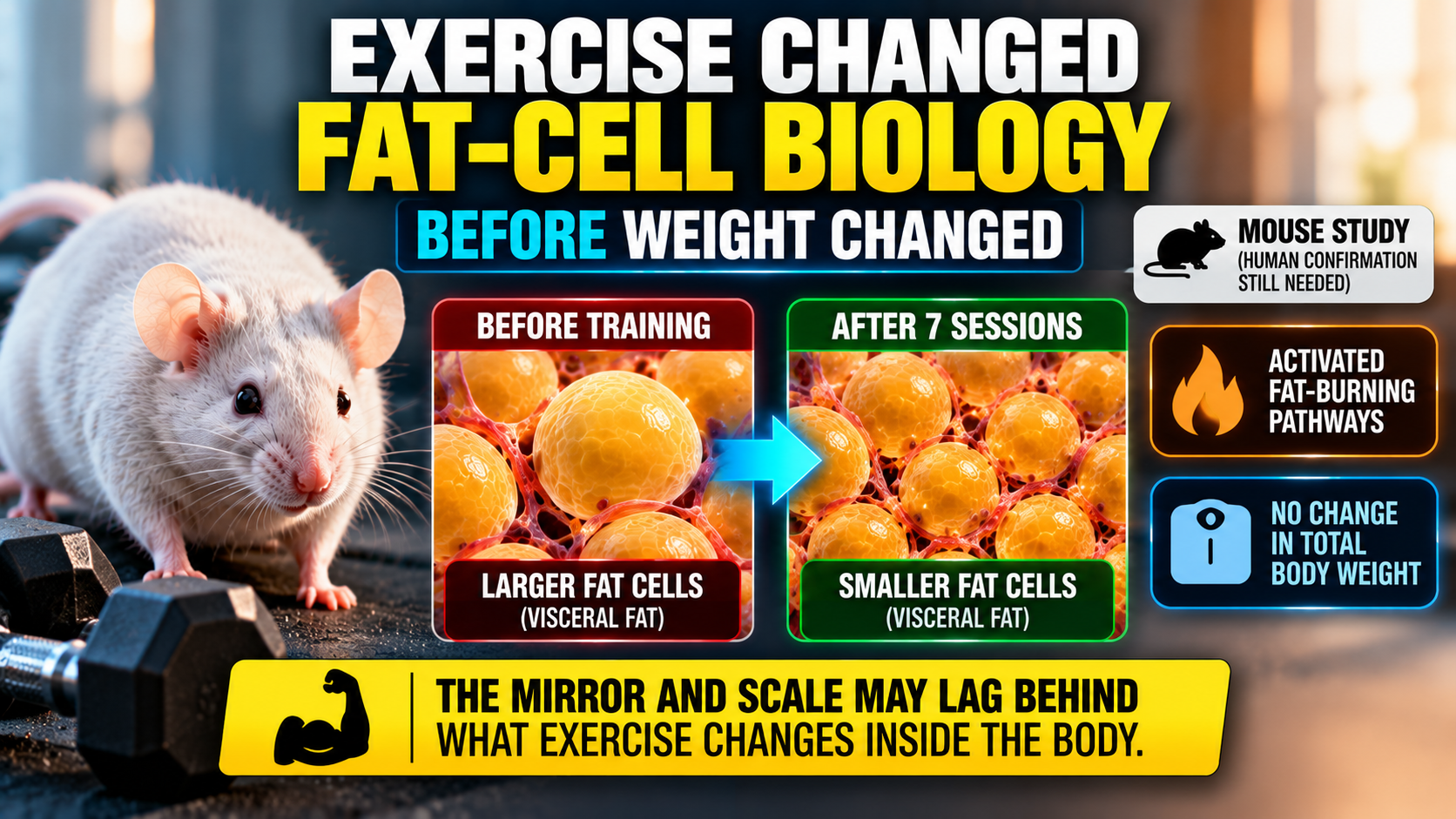
A new mouse study suggests that strength training may begin changing how visceral fat behaves before the number on the scale moves. After just seven sessions, researchers observed smaller fat cells and changes in molecular pathways involved in breaking down stored fat. The important caveat: these findings have not yet been confirmed in humans.
KEY BENEFITS
Earlier metabolic changes: Exercise-related changes appeared before total body weight changed.
Smaller visceral fat cells: Researchers observed reduced fat-cell size in obese mice.
Fat-breakdown pathways reactivated: Molecular signals involved in lipolysis became more active.
A reason to stay consistent: Visible weight loss may not capture every biological response to exercise.
A reminder to train for health: Strength training can be valuable even when the scale changes slowly.
THE MIRROR AND SCALE MAY LAG BEHIND THE BIOLOGY
What if exercise starts changing your body before you can see the results?
That is the intriguing possibility raised by a study reported by ScienceDaily on October 8, 2026. Researchers found that just seven strength-training sessions triggered measurable changes in visceral fat tissue in obese mice—even though their overall body weight did not decrease. <Cite refs={["turn224260search0"]}/>
The finding does not mean one week of lifting will shrink belly fat in men. But it offers a useful insight: body weight alone cannot tell the whole story of what exercise may be doing inside the body.
𝗪𝗛𝗔𝗧 𝗧𝗛𝗘 𝗥𝗘𝗦𝗘𝗔𝗥𝗖𝗛𝗘𝗥𝗦 𝗙𝗢𝗨𝗡𝗗
The study, published in Life Sciences, investigated male mice with diet-induced obesity. Some remained sedentary, while others completed seven strength-training sessions over one week.
The animals performed weighted ladder climbs designed to mimic the muscular effort of resistance exercise. Researchers then examined mesenteric fat tissue, which surrounds the intestines and is a type of visceral fat.
The exercising mice had less of this fat tissue and smaller fat cells than sedentary obese mice. Yet their total body weight had not changed. <Cite refs={["turn224260search0"]}/>
𝗜𝗡𝗦𝗜𝗗𝗘 𝗧𝗛𝗘 𝗙𝗔𝗧 𝗖𝗘𝗟𝗟𝗦
The researchers also examined the molecular machinery involved in fat metabolism.
They observed changes in the ABHD5–ATGL pathway, which helps break down stored triglycerides, along with changes in other proteins and gene activity associated with fat storage and breakdown.
In simple terms, the fat tissue showed signs of shifting toward greater fat breakdown—even before the scale registered weight loss. <Cite refs={["turn224260search0"]}/>
This is a biological finding, not proof that the mice lost a meaningful amount of body fat overall or that the same response will occur after seven workouts in humans.
𝗪𝗛𝗔𝗧 𝗧𝗛𝗜𝗦 𝗠𝗘𝗔𝗡𝗦 𝗙𝗢𝗥 𝗠𝗘𝗡 𝟯𝟱+
If you have started lifting weights but your weight has barely moved, it does not automatically mean your training is failing.
Body weight reflects several things, including fat, muscle, water and other tissues. It cannot show every change in body composition or metabolic function.
For practical progress, combine consistent resistance training with suitable aerobic activity, a sustainable eating pattern, adequate recovery and patience. Track more than weight alone: waist circumference, strength, fitness and how your clothes fit can provide additional context.
Do not treat this study as evidence that seven sessions will reduce human belly fat. The experiment involved mice, a specific training protocol and a short observation period. Human studies are needed to determine whether similar early changes occur in people and whether they lead to lasting health benefits.
𝗠𝗘𝗡𝟯𝟱 𝗧𝗔𝗞𝗘𝗔𝗪𝗔𝗬
The scale tells you how much you weigh—not everything that may be changing inside your body. Keep training consistently, measure progress in several ways and avoid judging a new exercise routine after only a few sessions.
𝗕𝗢𝗧𝗧𝗢𝗠 𝗟𝗜𝗡𝗘
Seven strength-training sessions changed visceral fat-cell size and fat-metabolism signals in obese mice before body weight changed. It is a promising clue about exercise biology, not yet a proven result in humans.
For informational purposes only. This is not medical advice — consult a doctor before changing medication, supplements or training.