Longevity · Video
Longevity Roundtable: GLP-1s, Statins, Aging Clocks, and Right to Try
YouTube — Longevity Roundtable · 04/10/2026 · added by men35 desk
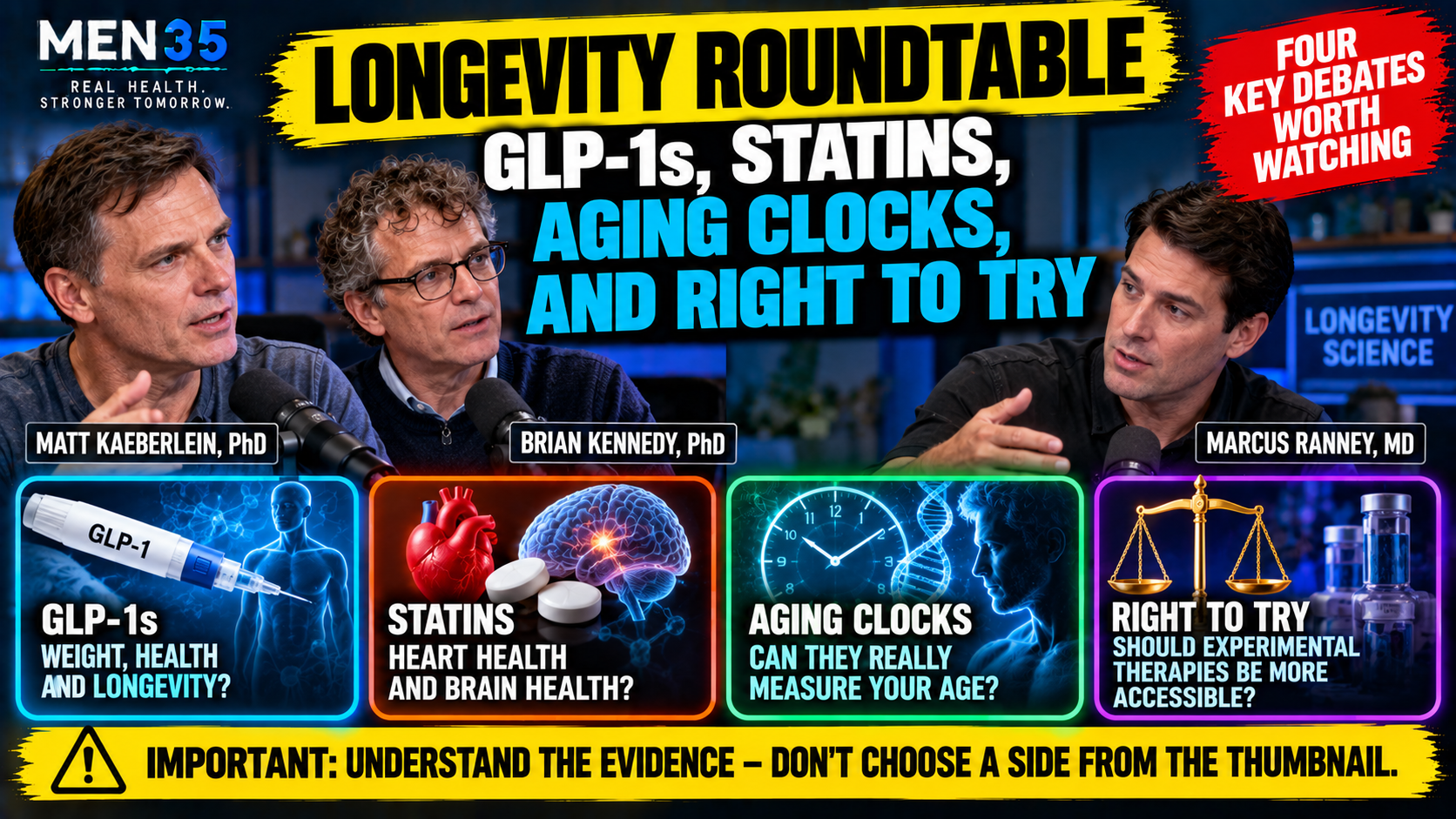
Longevity science is moving quickly—but not every promising result is ready for real-world use. In a September 25 roundtable, Matt Kaeberlein, Brian Kennedy and Marcus Ranney discuss GLP-1 drugs, statins, biological-age clocks and experimental-treatment access. The value of the discussion is not choosing a side, but understanding where the evidence is strong, where it is uncertain, and what still needs to be tested.
𝗞𝗘𝗬 𝗕𝗘𝗡𝗘𝗙𝗜𝗧𝗦
• Understand the current debate around GLP-1 drugs and longevity • See why statins and brain health are being reconsidered • Learn what biological-age clocks can—and cannot—tell us • Understand the debate around experimental therapies • Separate longevity research from proven medical treatment
𝗚𝗟𝗣-𝟭𝗦 𝗔𝗡𝗗 𝗟𝗢𝗡𝗚𝗘𝗩𝗜𝗧𝗬
The roundtable examines recent evidence surrounding GLP-1 drugs, including new mouse research involving semaglutide.
The animal findings are interesting because GLP-1 receptor activation has effects beyond weight and glucose control. However, the discussion emphasizes the gap between improved health markers or lifespan in mice and demonstrated lifespan extension in humans.
For MEN35 readers, the key point is simple: a drug can have established medical benefits without yet being proven as a longevity intervention for otherwise healthy people.
𝗦𝗧𝗔𝗧𝗜𝗡𝗦 𝗔𝗡𝗗 𝗕𝗥𝗔𝗜𝗡 𝗛𝗘𝗔𝗟𝗧𝗛
The discussion also examines evidence linking statin use with lower dementia risk.
This is important because cholesterol-lowering treatment has sometimes raised concerns about potential effects on the brain. The roundtable considers newer evidence suggesting that the relationship between cholesterol, statins and cognitive health may be more complicated than the common fear that “lower cholesterol is bad for the brain.”
That does not mean statins should be taken for dementia prevention by everyone. Their use remains dependent on cardiovascular risk and clinical indications.
𝗖𝗔𝗡 𝗔𝗚𝗜𝗡𝗚 𝗖𝗟𝗢𝗖𝗞𝗦 𝗧𝗘𝗟𝗟 𝗬𝗢𝗨𝗥 𝗔𝗚𝗘
Epigenetic clocks attempt to estimate biological age using molecular patterns.
They are increasingly used in longevity research, but the roundtable raises an important question: does a change in a biological-age clock actually mean an intervention has slowed aging?
Not necessarily.
A biomarker can change without proving that a person will live longer or remain healthier for longer. The relationship between clock measurements and meaningful clinical outcomes remains an active research question.
𝗧𝗛𝗘 𝗥𝗜𝗚𝗛𝗧 𝗧𝗢 𝗧𝗥𝗬 𝗗𝗘𝗕𝗔𝗧𝗘
The final major discussion concerns access to experimental therapies.
Montana's newer Right to Try framework is presented as an attempt to create a different pathway for people seeking experimental treatments. Kaeberlein discusses his involvement with the framework and the broader question of whether alternative regulatory approaches can increase access while still generating useful safety and clinical information.
This is fundamentally an evidence and policy debate—not an endorsement of trying unapproved longevity therapies.
𝗧𝗛𝗘 𝗕𝗜𝗚𝗚𝗘𝗥 𝗟𝗘𝗦𝗦𝗢𝗡
The most useful message from the roundtable is that longevity science contains several different evidence levels.
A promising mechanism is not the same as a successful animal experiment.
A successful animal experiment is not the same as a human clinical benefit.
And a human biomarker change is not automatically proof of longer life.
Understanding those distinctions is essential when evaluating the rapidly growing longevity market.
𝗠𝗘𝗡𝟯𝟱 𝗧𝗔𝗞𝗘𝗔𝗪𝗔𝗬
GLP-1s, statins, aging clocks and experimental therapies are all legitimate areas of scientific discussion—but they are not equally supported by evidence.
The smart approach is to ask three questions:
What has been demonstrated? What remains uncertain? What evidence would change the conclusion?
𝗧𝗛𝗘 𝗕𝗢𝗧𝗧𝗢𝗠 𝗟𝗜𝗡𝗘
Longevity research is producing increasingly interesting ideas, but the evidence ladder still matters.
Don't choose a longevity intervention because a thumbnail, podcast or headline makes it sound revolutionary. Look for human outcomes, appropriate clinical trials, meaningful endpoints and long-term safety data.
For informational purposes only. This is not medical advice — consult a doctor before changing medication, supplements or training.