Longevity · News
Could Gut Bacteria Help Protect Your Arteries? The C15:0 Discovery
Lifespan.io, October 9 · 19/10/2026 · added by men35 desk
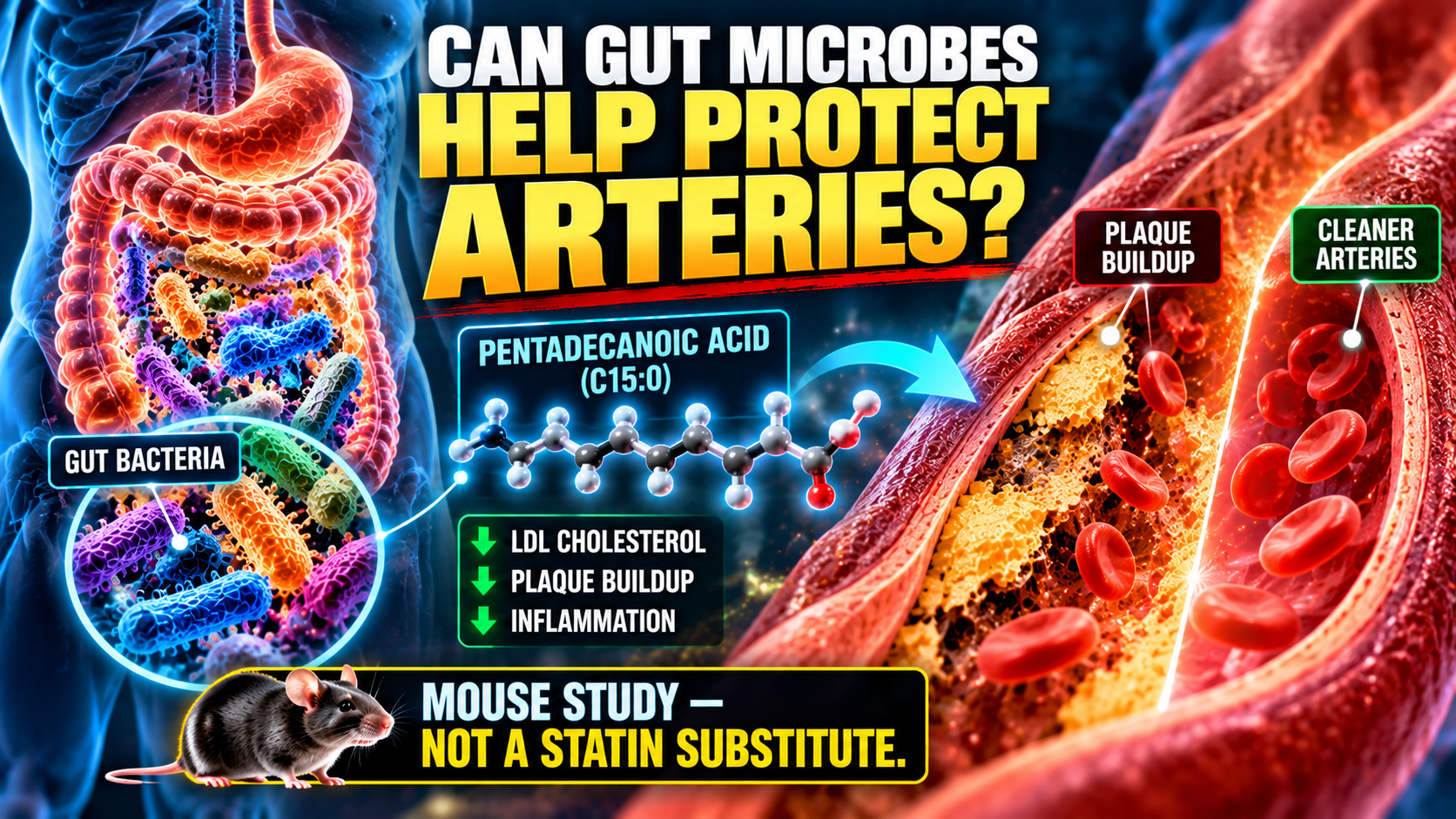
Your gut microbes do more than help digest food. Some produce molecules that may influence how your body handles cholesterol. In a new study, one bacterial fatty acid reduced artery plaque in mice by around 50%. Here is what researchers discovered—and why it is not a replacement for statins.
𝐊𝐄𝐘 𝐁𝐄𝐍𝐄𝐅𝐈𝐓𝐒
Discover how gut bacteria may influence cholesterol and artery health.
Understand the role of pentadecanoic acid (C15:0).
See how the compound affected artery plaque in mice.
Learn why this discovery is not yet a proven human treatment.
𝐓𝐇𝐄 𝐆𝐔𝐓–𝐇𝐄𝐀𝐑𝐓 𝐂𝐎𝐍𝐍𝐄𝐂𝐓𝐈𝐎𝐍
What if a molecule made by bacteria in your gut could influence what happens inside your arteries?
Researchers are investigating exactly that question. A study published in Nature on October 7, 2026, identified a fatty acid produced by certain gut bacteria that reduced atherosclerosis in mice.
The molecule is called pentadecanoic acid, or C15:0. In the experiments, it lowered LDL cholesterol and reduced artery plaque burden by around 50%.
That is a striking result. But the crucial detail is that the treatment was tested in mice—not established as a way to prevent heart attacks in humans.
𝐇𝐎𝐖 𝐂𝐎𝐔𝐋𝐃 𝐀 𝐆𝐔𝐓 𝐌𝐈𝐂𝐑𝐎𝐁𝐄 𝐀𝐅𝐅𝐄𝐂𝐓 𝐀𝐑𝐓𝐄𝐑𝐈𝐄𝐒?
Atherosclerosis develops when cholesterol-rich particles accumulate in artery walls, contributing to plaque formation and inflammation. Over time, these plaques can restrict blood flow or rupture, triggering a heart attack or stroke.
The liver plays a central role in controlling circulating LDL cholesterol. It uses LDL receptors to remove LDL particles from the bloodstream.
The research team investigated Bacteroides uniformis, a gut bacterium associated with healthier profiles in the human datasets they examined. In mice prone to atherosclerosis, administering the bacterium improved blood lipid measurements and reduced plaque burden.
The researchers then investigated what the bacterium was producing.
They identified C15:0 as one of the key molecules behind the effect.
𝐓𝐇𝐄 𝐅𝐀𝐓𝐓𝐘 𝐀𝐂𝐈𝐃 𝐁𝐄𝐇𝐈𝐍𝐃 𝐓𝐇𝐄 𝐑𝐄𝐒𝐔𝐋𝐓
C15:0 is a saturated fatty acid with 15 carbon atoms. In this study, it appeared to influence cholesterol production and clearance through a pathway involving an enzyme called HMG-CoA reductase.
That enzyme is important because it is also the target of statin medicines, which lower cholesterol by reducing the liver’s cholesterol production.
In the mouse experiments, purified C15:0 reduced plaque burden by approximately 50% and improved several blood lipid measurements. It also reduced inflammatory signals associated with plaque.
However, atorvastatin performed better than C15:0 in the researchers’ comparison. The findings therefore do not establish C15:0 as a superior or equivalent alternative to statin therapy.
The discovery is valuable because it identifies a possible gut–liver pathway that could be studied for future cardiovascular treatments.
𝐖𝐇𝐀𝐓 𝐃𝐈𝐃 𝐓𝐇𝐄 𝐇𝐔𝐌𝐀𝐍 𝐃𝐀𝐓𝐀 𝐒𝐇𝐎𝐖?
The researchers also examined human data. People with abnormal blood lipid levels had lower measured C15:0 concentrations than healthy controls. Analyses of existing microbiome datasets also found lower levels of genes associated with C15:0 production in people with atherosclerotic cardiovascular disease.
These observations make the research question more relevant to human health. But they do not prove that low C15:0 causes high cholesterol, or that taking a C15:0 supplement would lower it.
Human clinical trials would be needed to establish whether supplementation produces meaningful cardiovascular benefits and whether it is safe and effective.
𝐖𝐇𝐀𝐓 𝐒𝐇𝐎𝐔𝐋𝐃 𝐌𝐄𝐍 𝐎𝐕𝐄𝐑 𝟑𝟓 𝐃𝐎 𝐍𝐎𝐖?
Do not buy a supplement because a mouse study produced an impressive result. And do not stop or replace prescribed cholesterol medication based on this research.
For now, focus on cardiovascular measures with established benefits:
Check your cholesterol and other cardiovascular risk factors with your healthcare professional.
Follow a heart-healthy eating pattern rich in vegetables, legumes, fruit, whole grains, nuts and appropriate sources of unsaturated fats.
Exercise regularly, avoid smoking and manage blood pressure.
If you have been prescribed a statin, discuss any treatment changes with your clinician.
The gut microbiome may eventually provide new ways to influence cardiovascular health. But this study is an early research lead, not a new treatment recommendation.
𝐌𝐄𝐍𝟑𝟓 𝐓𝐀𝐊𝐄𝐀𝐖𝐀𝐘
A molecule made by gut bacteria reduced artery plaque in mice and affected a pathway involved in cholesterol regulation. That gives scientists a promising mechanism to investigate.
The next step is not to treat C15:0 as a “natural statin.” It is to test whether the findings translate into safe, meaningful benefits for people.
𝐁𝐎𝐓𝐓𝐎𝐌 𝐋𝐈𝐍𝐄
Gut microbes may influence artery health through molecules they produce—but a promising mouse result is not a proven human treatment. Protect your heart with established prevention strategies while researchers investigate what this discovery could mean.
For informational purposes only. This is not medical advice — consult a doctor before changing medication, supplements or training.