Health · Study
Prostate Cancer Treatment Choices Have Long-Term Trade-Offs
Newswise Men’s Health Research · 03/10/2026 · added by men35 desk
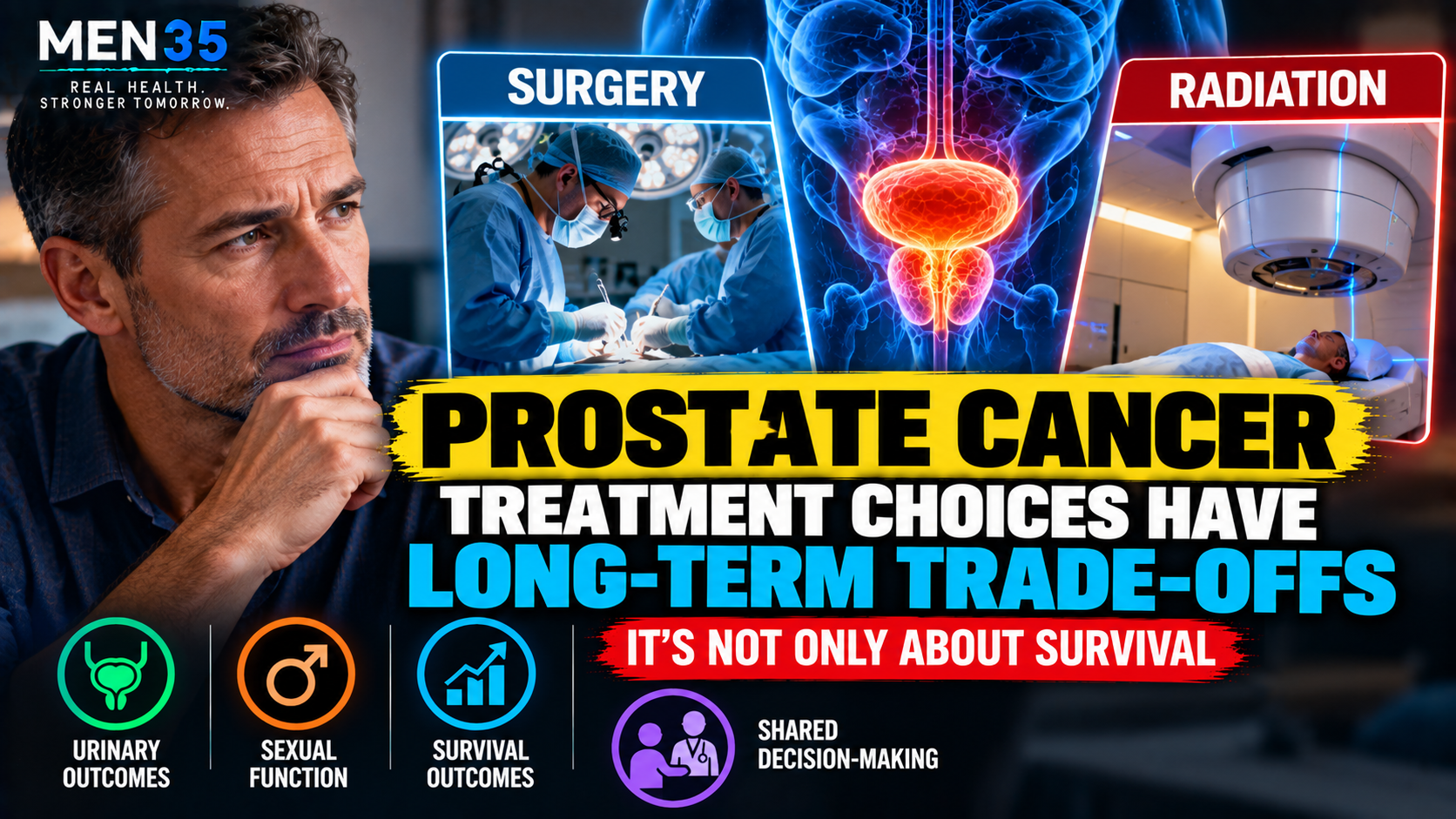
For men diagnosed with localized prostate cancer, treatment decisions can affect more than cancer control. A new American College of Surgeons analysis of more than 20,000 men found different long-term patterns of urinary, sexual and overall health outcomes after surgery or radiation. The findings reinforce why treatment decisions need to be individualized rather than reduced to a simple “best treatment” question.
𝗞𝗘𝗬 𝗕𝗘𝗡𝗘𝗙𝗜𝗧𝗦
• Shows the long-term trade-offs reported in a large observational study • Highlights urinary and sexual-function outcomes • Explains why the mortality finding requires caution • Puts surgery and radiation into a shared-decision framework • Helps men ask better questions before treatment
𝗪𝗛𝗔𝗧 𝗧𝗛𝗘 𝗦𝗧𝗨𝗗𝗬 𝗟𝗢𝗢𝗞𝗘𝗗 𝗔𝗧
Researchers analyzed medical records from more than 20,000 men with prostate cancer who underwent either radical prostatectomy or radiation therapy.
Each treatment group contained more than 10,000 men, with follow-up extending up to 20 years and a median follow-up of five years. Researchers used statistical matching to make the groups more comparable.
𝗨𝗥𝗜𝗡𝗔𝗥𝗬 𝗔𝗡𝗗 𝗦𝗘𝗫𝗨𝗔𝗟 𝗢𝗨𝗧𝗖𝗢𝗠𝗘𝗦
Surgery was associated with higher recorded rates of urinary incontinence and erectile dysfunction.
Urinary incontinence occurred in 28.5% of men after surgery compared with 6.1% after radiation. Erectile dysfunction was recorded in 35% versus 13.9%, respectively.
Radiation was associated with somewhat higher rates of several other urinary complications, including urinary retention, bladder inflammation and blood in the urine.
These figures describe differences observed in this particular study population; they should not be treated as predictions for every individual.
𝗧𝗛𝗘 𝗠𝗢𝗥𝗧𝗔𝗟𝗜𝗧𝗬 𝗙𝗜𝗡𝗗𝗜𝗡𝗚 𝗡𝗘𝗘𝗗𝗦 𝗖𝗔𝗨𝗧𝗜𝗢𝗡
The study reported higher all-cause mortality among men who received radiation: 7.8% compared with 6.5% among men who underwent surgery.
However, this was an observational study.
The researchers could not establish that radiation caused the difference in deaths. Other differences between patients may have influenced the result, and the analysis measured deaths from all causes rather than prostate-cancer-specific mortality.
The study is also an ACS Clinical Congress scientific abstract and, according to the ACS, had not yet undergone peer review at the time of reporting.
𝗧𝗛𝗘 𝗕𝗜𝗚𝗚𝗘𝗥 𝗣𝗜𝗖𝗧𝗨𝗥𝗘
Surgery and radiation are not the only considerations in localized prostate cancer.
Age, cancer risk category, overall health, life expectancy, baseline urinary and sexual function, treatment availability and personal priorities can all affect the decision.
For some men, active surveillance may also be appropriate depending on the cancer's characteristics.
Evidence from other studies similarly shows that prostate-cancer treatments can have different effects on urinary, bowel and sexual function over time.
𝗤𝗨𝗘𝗦𝗧𝗜𝗢𝗡𝗦 𝗙𝗢𝗥 𝗬𝗢𝗨𝗥 𝗨𝗥𝗢𝗟𝗢𝗚𝗜𝗦𝗧
Before choosing treatment, ask:
• What is my prostate-cancer risk category? • Is active surveillance reasonable for me? • What are the expected urinary, sexual and bowel effects of each option? • What are the short-term and long-term cancer-control expectations? • Should I meet both a urologic surgeon and a radiation oncologist? • Which factors in my own health make one approach more or less suitable?
The answers depend on the individual—not simply on which treatment appears better in one observational dataset.
𝗠𝗘𝗡𝟯𝟱 𝗧𝗔𝗞𝗘𝗔𝗪𝗔𝗬
Prostate-cancer treatment is about more than survival statistics.
Urinary control, sexual function, bowel effects, cancer risk and long-term quality of life can all matter. The new ACS analysis adds useful long-term information, but its observational design means the mortality difference cannot establish cause and effect.
𝗧𝗛𝗘 𝗕𝗢𝗧𝗧𝗢𝗠 𝗟𝗜𝗡𝗘
There is no universal prostate-cancer treatment decision that can be made from one study.
If you are diagnosed with localized prostate cancer, discuss the full range of appropriate options with qualified specialists and consider both cancer-control goals and the side effects that matter most to you.
For informational purposes only. This is not medical advice — consult a doctor before changing medication, supplements or training.