Strength · Study
ULTRA-PROCESSED FOOD AND HIDDEN MUSCLE FAT: WHAT IT COULD MEAN FOR YOUR KNEES
ScienceDaily Sports Medicine News · 02/10/2026 · added by men35 desk
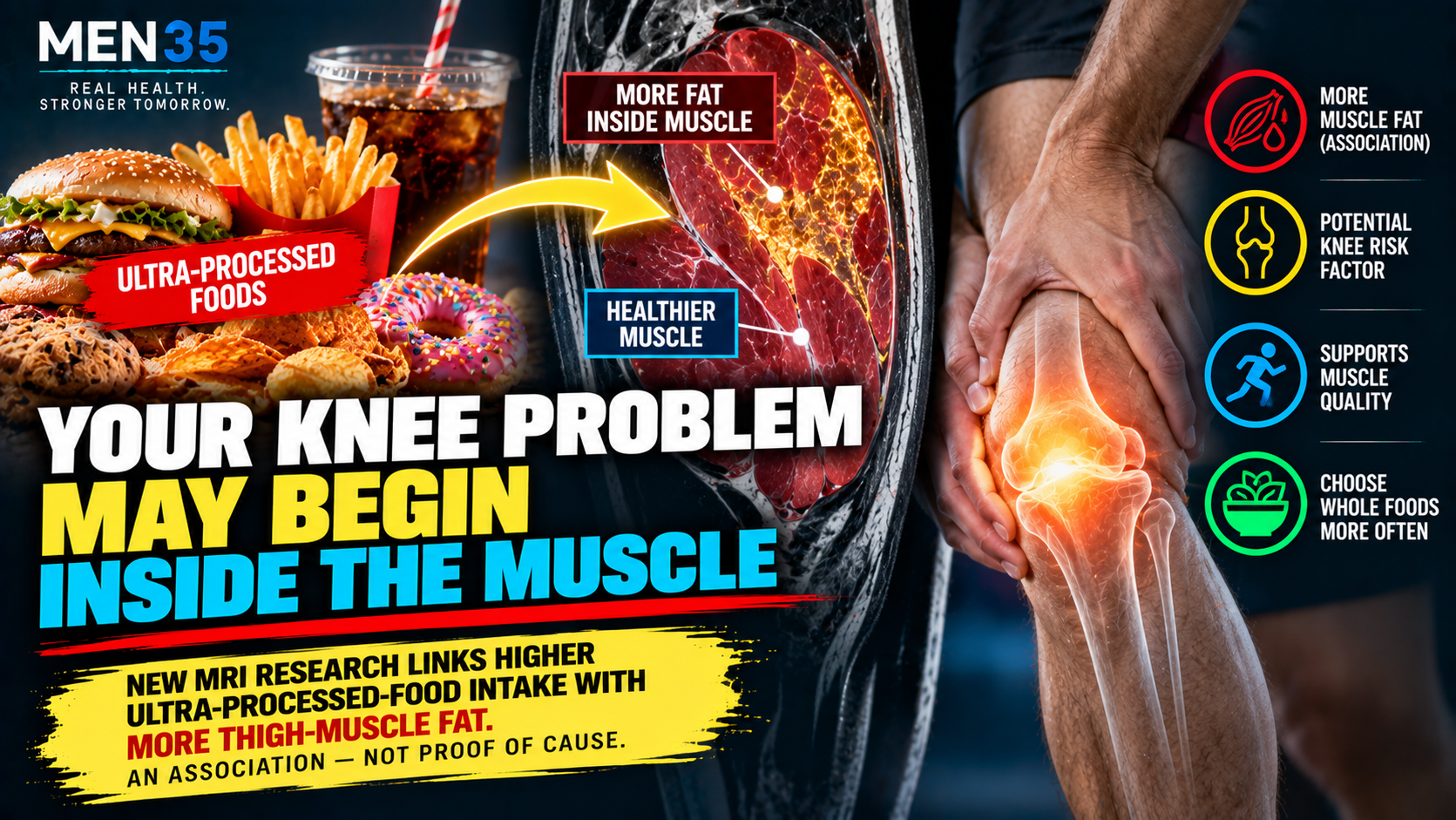
Your diet may influence more than your waistline. New MRI research found that adults who consumed a greater proportion of ultra-processed foods tended to have more fat stored inside their thigh muscles. Because muscle quality is important for supporting the knee, the finding raises an important question about diet and joint health—but it does not prove that ultra-processed foods cause knee osteoarthritis.
𝗞𝗘𝗬 𝗕𝗘𝗡𝗘𝗙𝗜𝗧𝗦
• Explains what “fat inside muscle” actually means • Examines the connection between diet quality and muscle composition • Shows what researchers found in 615 adults at risk for knee osteoarthritis • Explains why the findings do not prove causation • Gives men 35+ a practical reason to look beyond calories and consider food quality
𝗧𝗛𝗘 𝗛𝗜𝗗𝗗𝗘𝗡 𝗙𝗔𝗧 𝗜𝗡 𝗬𝗢𝗨𝗥 𝗠𝗨𝗦𝗖𝗟𝗘
When most people think about body fat, they picture fat stored underneath the skin or around the abdomen.
But fat can also accumulate within skeletal muscle.
Researchers call this muscle fat infiltration or intramuscular fat.
On an MRI scan, healthy muscle appears relatively uniform. With greater fat infiltration, streaks or areas of fatty tissue become visible between muscle fibers.
This matters because muscle composition is related to muscle quality and physical function.
𝗪𝗛𝗔𝗧 𝗧𝗛𝗘 𝗡𝗘𝗪 𝗦𝗧𝗨𝗗𝗬 𝗙𝗢𝗨𝗡𝗗
Researchers analyzed baseline data from 615 adults participating in the Osteoarthritis Initiative.
The participants were considered at risk for knee osteoarthritis but did not have radiographic knee osteoarthritis or knee or hip pain at the time of the analysis.
The average age was approximately 59.5 years, and 340 participants were women. Ultra-processed foods accounted for an average of about 41.4% of reported dietary intake.
Researchers used thigh MRI scans to assess muscle fat infiltration and compared those measurements with participants' reported intake of ultra-processed foods over the previous year.
The result was consistent:
Higher ultra-processed-food consumption was associated with greater fat infiltration in the thigh muscles.
𝗧𝗛𝗘 𝗔𝗦𝗦𝗢𝗖𝗜𝗔𝗧𝗜𝗢𝗡 𝗣𝗘𝗥𝗦𝗜𝗦𝗧𝗘𝗗
One interesting aspect of the analysis was that the association remained after researchers adjusted for several potential confounding factors.
These included:
• Total daily calorie intake • Physical activity • Smoking • Depression • Body mass index or abdominal circumference • Sociodemographic factors
The researchers found higher muscle-fat measurements with greater ultra-processed-food consumption in several thigh muscle groups.
That makes the finding interesting.
But it still does not turn an observational association into proof of cause and effect.
𝗪𝗛𝗬 𝗧𝗛𝗜𝗚𝗛 𝗠𝗨𝗦𝗖𝗟𝗘𝗦 𝗠𝗔𝗧𝗧𝗘𝗥
The quadriceps and other thigh muscles help stabilize and move the knee.
Previous research has found that changes in thigh-muscle composition, including increases in intramuscular adipose tissue, are associated with poorer knee-related outcomes.
A 2022 analysis of Osteoarthritis Initiative data found that increases in quadriceps intramuscular adipose tissue were associated with worsening symptoms and other adverse knee outcomes.
More recent systematic-review evidence has also found that greater intramuscular fat infiltration is associated with knee osteoarthritis, although the researchers emphasize that causality and the role of muscle-fat infiltration in disease progression remain uncertain.
This provides biological context for why the new diet finding deserves further investigation.
𝗗𝗜𝗗 𝗨𝗟𝗧𝗥𝗔-𝗣𝗥𝗢𝗖𝗘𝗦𝗦𝗘𝗗 𝗙𝗢𝗢𝗗𝗦 𝗖𝗔𝗨𝗦𝗘 𝗧𝗛𝗘 𝗠𝗨𝗦𝗖𝗟𝗘 𝗙𝗔𝗧?
We don't know.
This was a cross-sectional secondary analysis.
In simple terms, researchers examined dietary information and MRI measurements and looked for relationships between them.
That design can identify associations, but it cannot establish which factor came first.
There may also be other differences between people who consume more ultra-processed foods and those who consume less.
The authors themselves describe the findings as requiring further validation in larger longitudinal studies.
So the accurate headline is:
More ultra-processed food was associated with more thigh-muscle fat.
Not:
Ultra-processed food causes knee osteoarthritis.
That distinction matters.
𝗪𝗛𝗔𝗧 𝗖𝗢𝗨𝗡𝗧𝗦 𝗔𝗦 𝗨𝗟𝗧𝗥𝗔-𝗣𝗥𝗢𝗖𝗘𝗦𝗦𝗘𝗗?
Ultra-processed foods are generally industrial formulations made with multiple ingredients and processing techniques.
Examples can include:
• Packaged snacks • Sugary drinks • Candy and confectionery • Some ready-to-eat meals • Processed meat products • Certain packaged baked goods • Some highly formulated breakfast products
But “processed” does not automatically mean “bad.”
Frozen vegetables, pasteurized milk, canned beans and other minimally processed foods can be extremely useful parts of a healthy diet.
The practical issue is the overall dietary pattern, not whether every packaged food must be eliminated.
𝗧𝗛𝗘 𝗠𝗘𝗡𝟯𝟱 𝗙𝗢𝗢𝗗-QUALITY CHECK
For men over 35, the useful takeaway isn't to obsess over one food classification.
Instead, ask a simpler question:
How much of my normal diet comes from minimally processed, nutrient-dense foods?
A practical foundation includes:
• Vegetables and fruit • Beans and legumes • Whole grains • Nuts and seeds • Fish and other quality protein sources • Eggs, dairy or suitable alternatives • Minimally processed meat and poultry • Adequate fiber and water
Then look at the frequency of highly processed snacks, sugary drinks and ready-to-eat foods.
You don't need dietary perfection.
You need a sustainable pattern that makes nutrient-dense foods the default.
𝗪𝗛𝗔𝗧 𝗧𝗛𝗜𝗦 𝗠𝗘𝗔𝗡𝗦 𝗙𝗢𝗥 𝗬𝗢𝗨𝗥 𝗞𝗡𝗘𝗘𝗦
The study does not mean that eating one packaged meal will damage your muscles or that eliminating ultra-processed foods will prevent arthritis.
The more reasonable interpretation is that diet quality may be another factor worth considering when thinking about muscle composition and joint health.
This is particularly relevant after 35, when maintaining muscle mass, strength, body composition and physical activity becomes increasingly important.
Nutrition and exercise should therefore be viewed together rather than as competing strategies.
𝗠𝗘𝗡𝟯𝟱 𝗧𝗔𝗞𝗘𝗔𝗪𝗔𝗬
The interesting finding isn't that researchers discovered a new “knee food.”
It's that dietary quality was associated with something you normally cannot see in the mirror: fat stored inside thigh muscle.
MRI research found more intramuscular thigh fat among people consuming more ultra-processed food.
But this was an observational association—not proof that ultra-processed foods cause muscle-fat accumulation or knee osteoarthritis.
𝗧𝗛𝗘 𝗕𝗢𝗧𝗧𝗢𝗠 𝗟𝗜𝗡𝗘
Your knee health isn't determined by one food category.
But the quality of your overall diet can be part of the bigger picture.
This study adds an intriguing piece of evidence linking ultra-processed-food intake with thigh-muscle composition.
For men 35+, the practical response is simple: prioritize nutrient-dense foods, maintain muscle through resistance training and stay physically active.
The science is still developing—but improving food quality is a reasonable health habit even while researchers work out exactly how these associations translate into long-term joint outcomes.
For informational purposes only. This is not medical advice — consult a doctor before changing medication, supplements or training.