Longevity · Study
CAN THE THYMUS BE REBUILT? NEW MOUSE STUDY GROWS THYMIC TISSUE INSIDE THE SPLEEN
Lifespan Research Institute · 01/10/2026 · added by men35 desk
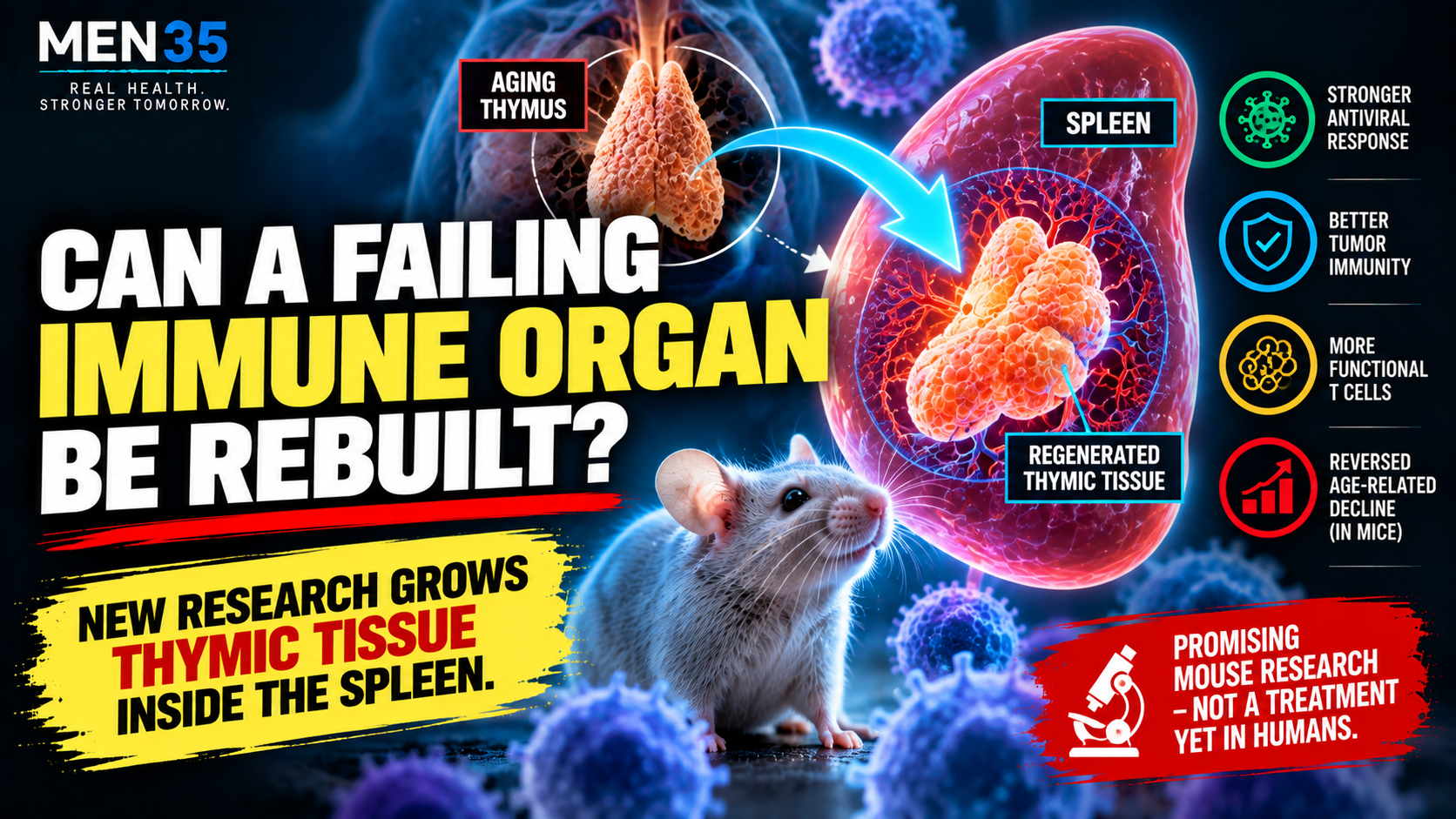
The thymus is central to the development of T cells, but it gradually shrinks with age. New research has demonstrated an unusual regenerative strategy: researchers implanted cultured thymic tissue into the spleens of mice, where it developed organized thymus-like structures and restored functional T-cell immunity. The regenerated tissue improved responses to viral infections and tumors. The approach is promising, but it remains experimental and has a long path before human clinical use.
𝗞𝗘𝗬 𝗕𝗘𝗡𝗘𝗙𝗜𝗧𝗦
• Explains why the thymus becomes important again as we age • Shows how researchers regenerated thymic tissue inside the spleen • Explains the connection between the thymus and T-cell immunity • Examines the antiviral and antitumor results in mice • Clearly separates regenerative research from treatments available today
𝗪𝗛𝗬 𝗧𝗛𝗘 𝗧𝗛𝗬𝗠𝗨𝗦 𝗠𝗔𝗧𝗧𝗘𝗥𝗦
The thymus is a small organ located behind the breastbone, but it plays a major role in adaptive immunity.
It is where developing T cells mature and undergo selection. This process helps create T cells capable of recognizing threats while reducing the likelihood that they attack the body's own tissues.
The problem is that the thymus does not remain fully active throughout life.
After reaching maturity, the organ progressively undergoes a process called thymic involution. The amount of functional thymic tissue declines, and production of new naïve T cells decreases.
That age-related change is one reason researchers are interested in thymus regeneration.
𝗧𝗛𝗘 𝗡𝗘𝗪 𝗜𝗗𝗘𝗔: 𝗚𝗥𝗢𝗪 𝗜𝗧 𝗜𝗡 𝗧𝗛𝗘 𝗦𝗣𝗟𝗘𝗘𝗡
The researchers from Nanjing University developed what they called intrasplenic thymus regeneration, or ISTR.
Instead of attempting to rebuild the thymus in its original location, they implanted cultured thymic tissue fragments into the spleen.
Why the spleen?
The spleen has an extensive blood supply and a supportive cellular environment. The researchers found that these characteristics provided a favorable environment for thymic tissue to develop.
𝗧𝗛𝗘 𝗧𝗜𝗦𝗦𝗨𝗘 𝗔𝗖𝗧𝗨𝗔𝗟𝗟𝗬 𝗗𝗘𝗩𝗘𝗟𝗢𝗣𝗘𝗗
The researchers initially worked with mice lacking normal thymic function.
They cultured thymic fragments before transplantation to remove many mature donor immune cells while preserving important thymic epithelial structures.
The tissue was then implanted into either the spleen or muscle.
The difference was substantial.
Thymic tissue implanted into the spleen developed faster and formed recognizable cortical and medullary regions—the two major structural compartments of a functional thymus.
Splenic grafts also became substantially larger than muscle grafts and generated more developing T cells.
𝗧𝗛𝗘 𝗜𝗠𝗠𝗨𝗡𝗘 𝗦𝗬𝗦𝗧𝗘𝗠 𝗦𝗧𝗔𝗥𝗧𝗘𝗗 𝗥𝗘𝗕𝗨𝗜𝗟𝗗𝗜𝗡𝗚
The important question was not simply whether tissue could grow.
Could it actually produce functional immune cells?
The answer in these animal models was encouraging.
After transplantation, circulating T cells appeared and increased over time. The regenerated thymic tissue supported development of diverse T-cell populations.
The researchers also found evidence that the newly generated T cells could respond to antigens rather than simply existing in the bloodstream.
𝗖𝗔𝗡 𝗧𝗛𝗘𝗦𝗘 𝗧 𝗖𝗘𝗟𝗟𝗦 𝗙𝗜𝗚𝗛𝗧 𝗩𝗜𝗥𝗨𝗦𝗘𝗦?
The researchers tested that question using viral infection models.
Following vesicular stomatitis virus exposure, mice receiving splenic thymus grafts showed stronger T-cell activation and better control of viral replication than untreated athymic mice.
The regenerated immune system therefore wasn't simply producing T cells—it was producing cells capable of participating in an antiviral response.
𝗔𝗡𝗗 𝗪𝗛𝗔𝗧 𝗔𝗕𝗢𝗨𝗧 𝗖𝗔𝗡𝗖𝗘𝗥?
The researchers also tested tumor models.
Mice receiving the splenic thymus grafts showed stronger immune control of B16 melanoma, with smaller tumors and greater T-cell infiltration than untreated nude mice.
The study also included a human colorectal cancer xenograft model. In that experiment, tumors developed in untreated nude mice but were rejected in the splenic-graft group.
These findings suggest that regenerated T-cell immunity can translate into measurable antitumor activity in experimental animals.
𝗧𝗛𝗘 𝗔𝗚𝗜𝗡𝗚 𝗤𝗨𝗘𝗦𝗧𝗜𝗢𝗡
The researchers didn't stop with young animals lacking normal thymic function.
They also transplanted neonatal thymic tissue into naturally aged mice.
The splenic grafts developed organized thymic structures and contained developing T cells. The treatment also increased naïve T-cell populations compared with aged controls.
This is particularly relevant to longevity research because thymic involution is a normal feature of aging.
𝗧𝗛𝗘𝗥𝗘 𝗜𝗦 𝗘𝗩𝗘𝗡 𝗔 𝗛𝗨𝗠𝗔𝗡 𝗖𝗢𝗠𝗣𝗢𝗡𝗘𝗡𝗧
One of the more interesting parts of the study involved humanized mice.
Researchers implanted cryopreserved human thymic fragments into immunodeficient mice containing human blood-forming stem cells.
Human thymic tissue survived more effectively in the spleen than in muscle, and combining the thymic tissue with human hematopoietic stem cells resulted in stronger development of human T cells.
This is still a humanized-mouse experiment, not a human clinical trial.
𝗪𝗛𝗬 𝗧𝗛𝗜𝗦 𝗜𝗦 𝗡𝗢𝗧 𝗔 𝗧𝗥𝗘𝗔𝗧𝗠𝗘𝗡𝗧 𝗙𝗢𝗥 𝗠𝗘𝗡 𝟯𝟱+
This is where the evidence needs to be kept in perspective.
The researchers did not implant thymic tissue into human patients.
They did not demonstrate that the procedure is safe in humans.
They did not establish long-term effects.
They did not determine whether regenerated thymic tissue would behave identically to a natural human thymus.
And they did not establish that reversing thymic involution would extend human lifespan.
There are also major practical challenges involving transplantation, immune compatibility, tissue sourcing, surgical delivery, safety and long-term immune regulation.
The authors describe the approach as a potential strategy for future clinical immune reconstitution—not as an established human therapy.
𝗪𝗛𝗔𝗧 𝗧𝗛𝗜𝗦 𝗖𝗢𝗨𝗟𝗗 𝗠𝗘𝗔𝗡 𝗙𝗢𝗥 𝗙𝗨𝗧𝗨𝗥𝗘 𝗔𝗚𝗜𝗡𝗚 𝗥𝗘𝗦𝗘𝗔𝗥𝗖𝗛
The bigger idea is not simply “put a thymus in the spleen.”
It is that an aging organ might potentially be replaced or regenerated by giving its specialized cells an appropriate biological environment.
If researchers can eventually reproduce this safely in humans, thymus regeneration could have applications in situations involving severe immune deficiency, age-related immune decline or immune-system recovery following certain medical treatments.
But those possibilities remain research questions.
𝗠𝗘𝗡𝟯𝟱 𝗘𝗩𝗜𝗗𝗘𝗡𝗖𝗘 𝗟𝗔𝗗𝗗𝗘𝗥
Established biology: The thymus is essential for T-cell development, and thymic function declines with age.
Preclinical evidence: Thymic tissue implanted into mouse spleens can develop organized thymic structures and restore T-cell production.
Functional animal evidence: The regenerated immune system demonstrated antiviral and antitumor activity in mouse models.
Humanized-animal evidence: Human thymic tissue supported human T-cell development in humanized mice.
Human clinical evidence: Not yet established.
𝗪𝗛𝗔𝗧 𝗠𝗘𝗡 𝟯𝟱+ 𝗦𝗛𝗢𝗨𝗟𝗗 𝗧𝗔𝗞𝗘 𝗙𝗥𝗢𝗠 𝗜𝗧
Don't read this research as a new immune-boosting treatment.
The more useful conclusion is that researchers are beginning to explore whether age-related loss of thymic function can be addressed through tissue regeneration.
That is a much bigger scientific challenge than taking a supplement.
For now, the study is best viewed as a glimpse into the future of regenerative immunology.
𝗠𝗘𝗡𝟯𝟱 𝗧𝗔𝗞𝗘𝗔𝗪𝗔𝗬
Your immune system changes as you age, and the shrinking of the thymus is part of that process.
This study demonstrates an impressive concept in mice: thymic tissue can be grown inside the spleen and can restore meaningful T-cell function.
But the distance between a successful mouse experiment and a safe human therapy is substantial.
𝗧𝗛𝗘 𝗕𝗢𝗧𝗧𝗢𝗠 𝗟𝗜𝗡𝗘
Researchers have demonstrated that the spleen can act as a supportive environment for regenerating thymic tissue in mice.
The regenerated tissue produced functional T cells and improved responses to experimental viral infections and tumors.
For humans, however, this remains experimental regenerative-immunology research.
The exciting part isn't that a new treatment is available.
It's that scientists may be getting closer to understanding whether an aging immune organ can one day be rebuilt.
For informational purposes only. This is not medical advice — consult a doctor before changing medication, supplements or training.